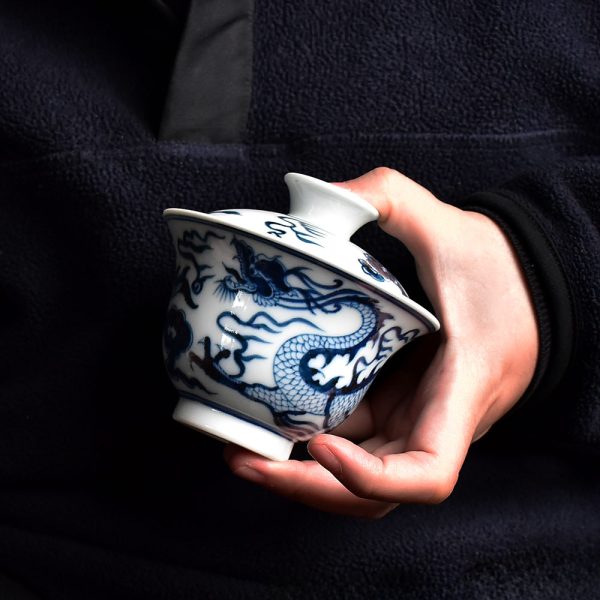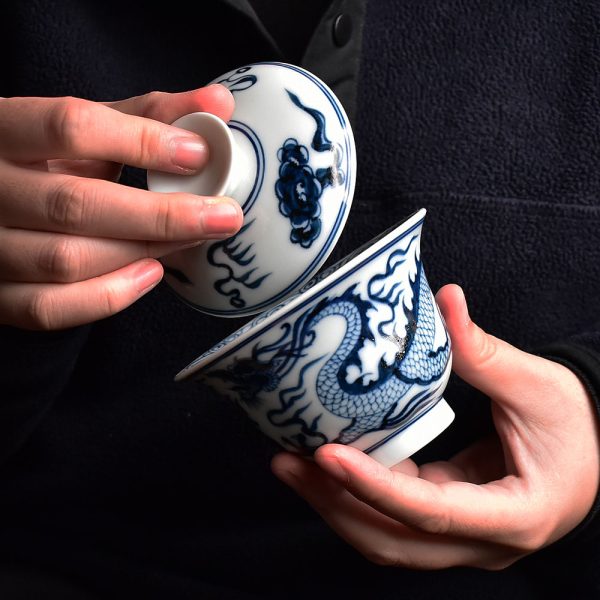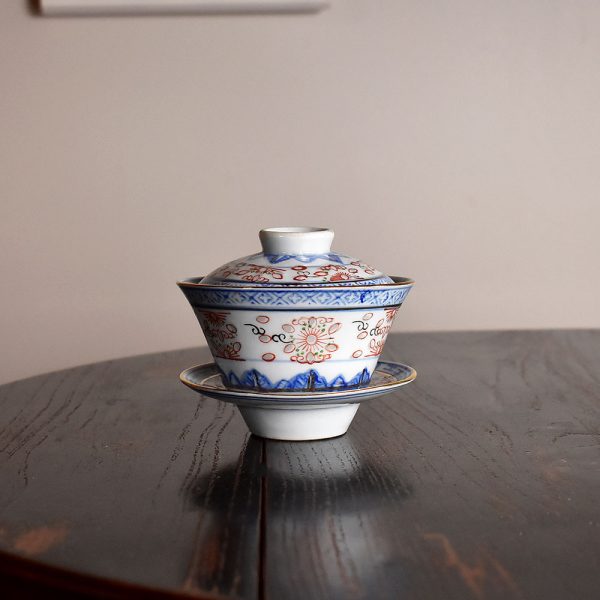
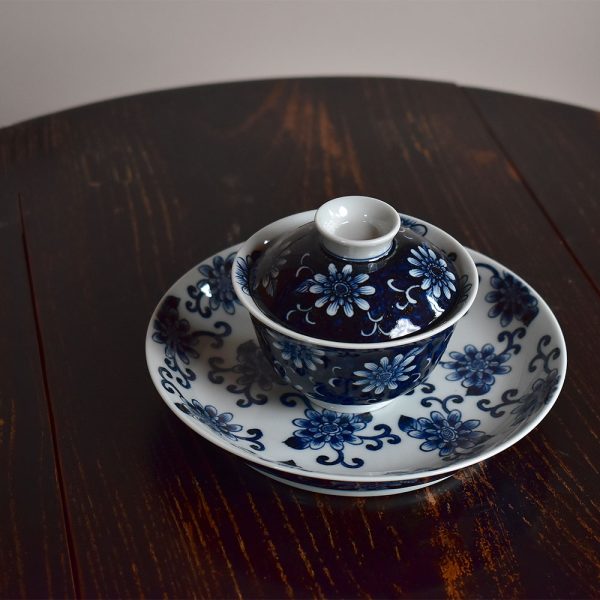
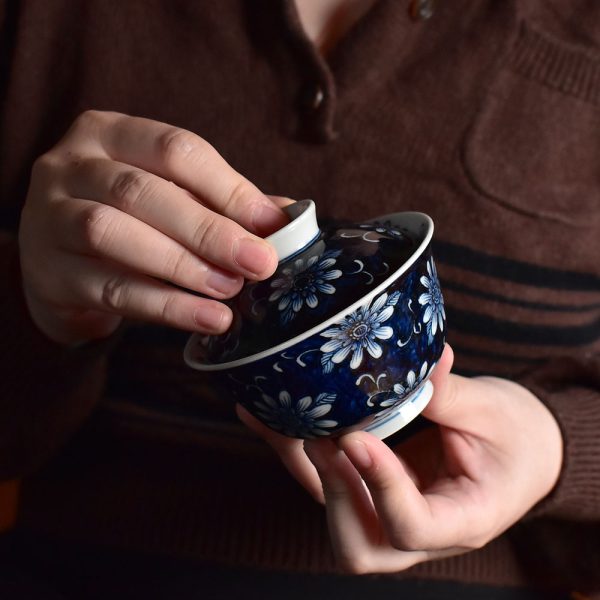
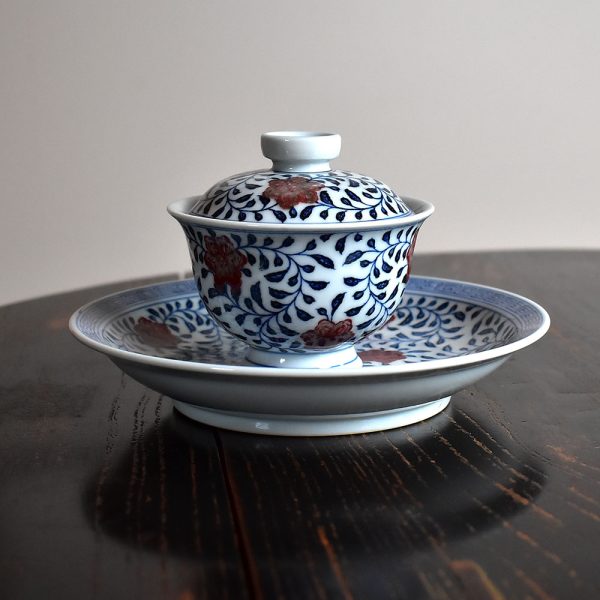
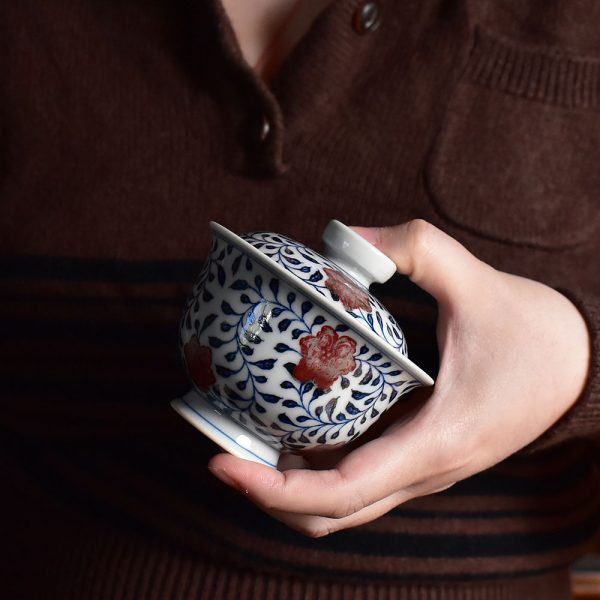
This blue and coloured reticulated gaiwan features a proper yet slightly rough form, typical of early or folk kiln wares. The body is relatively thick, with uneven glaze lustre and somewhat freehand cobalt lines, giving it an authentic handmade texture. The vessel is crafted using the traditional reticulated carving technique, with tiny translucent holes visible when held to light. Under the glaze, blue decoration is applied, while red and green overglaze enamels add a lively contrast. Though the colouring lacks delicacy, it carries a rustic charm. The lid, bowl, and saucer form a complete three-piece set, simple and steady in proportion, reflecting the aesthetics of old-style Jingdezhen porcelain.
Reticulated porcelain, also known as ‘transparent porcelain,’ first appeared during the Jiajing period of the Ming dynasty and reached its peak during the Kangxi and Qianlong reigns of the Qing dynasty. Its distinctive technique involves carving fine holes into the clay body before glazing and high-temperature firing, allowing glaze to fill the openings and form translucent ‘windows.’ When illuminated, these patterns emit a soft glow. Due to the complexity of the process and its low success rate, reticulated porcelain has long been regarded as one of Jingdezhen’s unique crafts. By the late Qing and Republic periods, blue-and-coloured reticulated gaiwans became common household items—less refined in craftsmanship but closer to everyday life.
This particular gaiwan belongs to that period of practical ware. Though not luxurious, it embodies the warmth of hand-fired ceramics and the quiet charm of daily use.
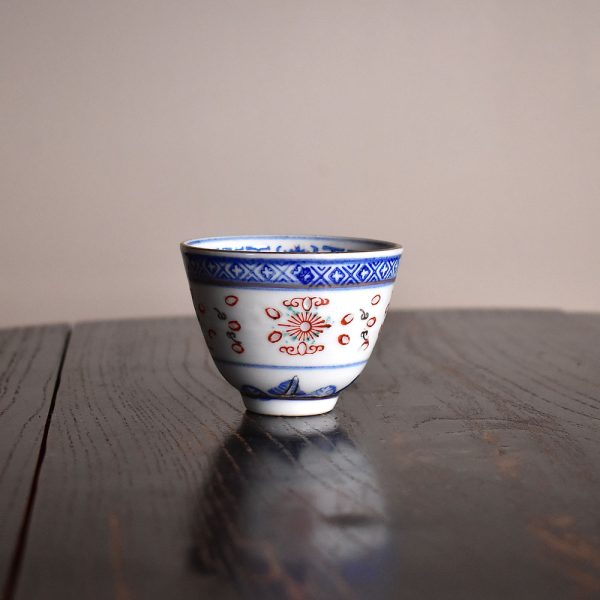
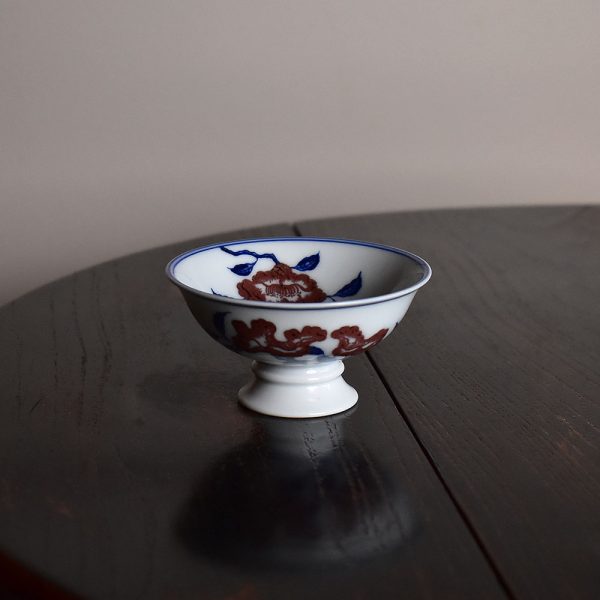
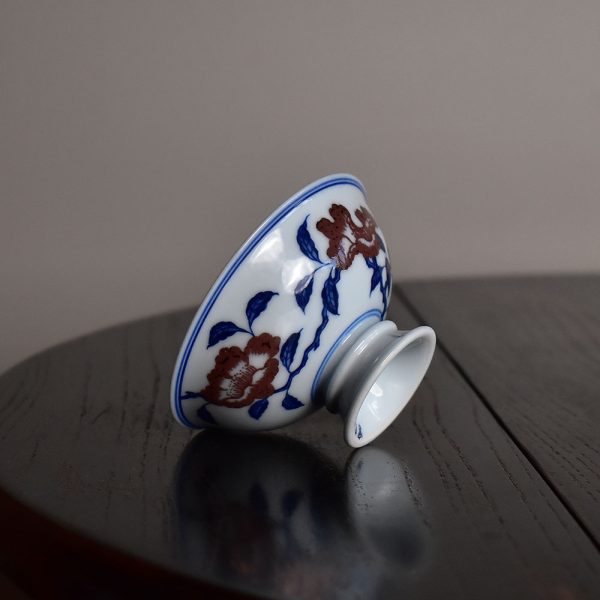
This is an old-style blue and reticulated teacup, with a dense and fine body and a soft, mellow glaze that reflects the traditional characteristics of Jingdezhen folk kilns. The form is small and upright, well-proportioned, with smooth natural lines typical of early gongfu tea cups. The exterior is decorated with entwined floral motifs in underglaze blue, complemented by touches of overglaze red, creating a modest yet charmingly rustic visual harmony.
The entire cup is crafted using the traditional reticulated (linglong) technique, with fine translucent holes visible when held to light. The glaze seeps into these openings during firing, forming semi-transparent ‘windows.’ Under illumination, the patterns faintly shimmer through the porcelain, revealing a soft and gentle translucence. The base is marked ‘Made in China,” indicating that it was produced in the mid-20th century in Jingdezhen as an old-style folk kiln piece. Compared with official kiln wares, this cup shows a rougher finish—blue lines appear slightly blurred and the glaze varies in thickness—but these imperfections enhance its authenticity and capture the warmth of traditional handcraftsmanship.
Reticulated porcelain, also known as ‘transparent porcelain’, originated during the Jiajing period of the Ming dynasty and reached its peak in the Kangxi and Qianlong reigns of the Qing dynasty. The process is highly intricate, involving the carving of tiny holes in the clay body before glazing and high-temperature firing, allowing the glaze to fill the openings and produce a luminous, translucent effect. By the late Qing and Republic periods, blue and reticulated tea wares had become common household items, valued for their practicality and for embodying the daily charm of traditional Chinese tea culture.
This elegant tea set features a serene countryside design and includes a teapot with a “Meiren Jian” (Beauty Shoulder) shape, a fairness pitcher, and four tea cups. Each piece is adorned with hand-painted blue-and-white landscape patterns that depict a tranquil village scene. The flowing river, lush trees, distant houses, and soaring birds evoke a sense of natural harmony and rustic charm.
The teapot stands out with its graceful “Beauty Shoulder” design, where the soft, smooth lines of the shoulder resemble the curve of a beauty’s shoulder, exuding elegance and sophistication. The spout is naturally curved for smooth pouring, while the handle offers a comfortable grip for ease of use. The lid fits seamlessly with the teapot, ensuring that the tea’s warmth and aroma are retained, combining functionality with aesthetic appeal. The tea cups are well-proportioned, with slightly flared rims that enhance drinking comfort while adding a touch of refinement. The fairness pitcher complements the set with its simple and elegant design, creating a cohesive and harmonious style.
The deep and vibrant blue glaze contrasts beautifully with the pristine white porcelain, creating a fresh and refined visual effect. This tea set is not only a practical tool for brewing tea but also a collectible piece that blends traditional craftsmanship with artistic value. Whether for daily use or as a thoughtful gift for friends and family, it reflects both taste and a reverence for cultural heritage.
This blue and white tea set captures the tranquility of a countryside scene, depicting a poetic landscape where the sun sets and birds return home. The set includes a gaiwan, a fairness cup, and teacups, all hand-painted with traditional blue and white craftsmanship, exuding an elegant and serene oriental charm.
The gaiwan features a picturesque village nestled among rolling hills and lush trees, evoking the imagery of a peaceful retreat away from the world. The teacups complement this design, portraying distant mountain ranges, flocks of birds, and the warm glow of the setting sun, creating a harmonious and tranquil atmosphere.
The fairness cup is made of transparent glass, presenting a simple yet sophisticated contrast to the blue and white porcelain, adding depth and texture to the overall aesthetic. This thoughtfully designed tea set not only highlights the timeless beauty of traditional Chinese porcelain but also imbues tea-drinking with a poetic sense of tranquility. Whether for daily tea rituals or elegant gatherings, this set offers a peaceful and refined tea experience.
This teacup, designed in the style of the Ming Dynasty, is crafted using the underglaze blue and white porcelain technique, and is entirely hand-painted. The intricate and exquisite artwork features peach blossoms, ducks, butterflies, and the spring river. Two adult ducks, accompanied by ducklings, swim freely in the warming spring waters, surrounded by blooming peach blossoms and playful butterflies. The scene is vivid and natural, evoking a serene beauty. The artwork captures the essence of early spring on the river, portraying how ducks are the first to sense the warming waters, expressing joy and reverence for the arrival of spring.
Design and Appearance
Shape: The teacup has smooth lines and a comfortable grip, combining unique and beautiful design elements.
Glaze Colour: The surface of the teacup has a warm and smooth glaze. The base color is white, with the hand-painted underglaze blue technique, creating a deep and layered blue color.
Craftsmanship and Techniques
Hand-Painted Artwork: The designs on the teacup are meticulously hand-painted, making each piece unique and full of artistic value.
Tin Spot Technique: The glaze surface uses the tin spot technique, creating a mottled visual effect that adds a sense of history and texture, enhancing the antique charm of the teacup.
Ming-style teaware always features a distinctive tin spot pattern, giving the tea ware a unique charm. The formation of tin spots is due to the high content of iron elements in local parts of the blue pigment. After reaching saturation in the high-temperature glaze solution and cooling down, the iron elements in the supersaturated part start to precipitate. If the iron content of the blue pigment is higher and the cooling rate is appropriate, tin spots are more likely to appear on the surface of the ware.
In addition to firing and materials, the formation of tin spots also involves the factor of glaze material. During the painting process, tin spots can also be formed due to the accumulation of blue pigment. Tin spots are more likely to appear on the surface of the ware at the intersections and the starting and ending points of brushstrokes. The formation of tin spots can be said to be a natural creation or an artificial decoration. These tin glazes not only add a rustic texture to the teacup but also imbue it with a unique sense of history.
The artwork on this teacup is delicate, with fine brushstrokes that outline a unique sense of line beauty. The underglaze blue pigment is rich, featuring distinctive and prominent tin spots that appear exceptionally beautiful and captivating under the light.
This Baoxiang teacup is completely handmade and hand painted. The special craft used in this teaware includes Blue and white underglaze colour and underglaze red.
The pattern featured is called “Bao Xiang” in Chinese, which is a traditional decorative motif representing one of the auspicious three treasures (Bao Xiang flower, Money tree, and Treasure basin), prevalent during the Sui and Tang dynasties in China. Bao Xiang pattern is also known as ‘Bao Xian Hua’ or ‘Bao Lian Hua’. Its lines are clear, and the colour is serene and antique. The Bao Xiang pattern design of this teaware is neat, and complex but not messy, and the whole picture of it is full and rich in details.
In Chinese culture, the Bao Xiang pattern symbolizes auspiciousness and happiness, representing people’s aspirations for happiness. It is widely popular in the decoration of silk brocade, bronze mirrors, and porcelain, showcasing people’s pursuit of a better life.
This teacup features smooth and concise curves, combining the unique beauty of the Bao Xiang pattern, creating a visually appealing and enjoyable tea-drinking experience.
This teacup takes the classic form of a master’s master teacup with a censer-like profile. The rim flares slightly outward, the belly is full, and the foot ring is steady and well balanced. The overall lines are simple and dignified, lending an elegant presence on the tea table.
The outer wall is painted in blue and white with entwined lotus motifs, with branches and blossoms interwoven, symbolizing continuity and vitality. At the bottom of the interior lies a single lotus, its full bloom and spreading petals representing purity, integrity, and auspiciousness. This design approach of outer complexity and inner simplicity not only enhances its decorative beauty but also carries cultural meanings rooted in Confucian and Buddhist traditions.
The blue coloration is pure and refined, the contrast of blue and white crisp and harmonious, with a glossy and smooth glaze. Whether admired on a desk or used during tea gatherings, it reflects the taste and elegance of its owner.
As a master master teacup, it serves not only as the exclusive tea vessel signifying the host’s role in a tea setting but also as a symbol of etiquette and respect during refined gatherings.
This Gaiwan is made in the style of the Yuan dynasty blue and white porcelain, completely handmade and hand painted. The pattern of “一鹭莲科” or “一路连科” in Chinese culture is derived from the beautiful combination of the heron and lotus leaves. As “鹭” (heron) and “路” (path/road) have the same pronunciation, and “莲” (lotus) sounds like “连” (successive/continuous), the name “一路连科” is a play on words that conveys the beautiful meaning of the pattern. In ancient times, successive successful candidates in the imperial examinations were called “连科,” and “一路连科” is a good wish for students to have a smooth career path and achieve success step by step.
For Yuan blue and white porcelain refers to the blue and white porcelain produced during the Yuan dynasty (1271-1368) in China. The Yuan dynasty was an important period in the history of Chinese porcelain and one of the peaks of Chinese porcelain art. As one of the representatives of that era, Yuan blue and white porcelain exhibited unique artistic styles and technical levels. The characteristic of Yuan blue and white is the use of cobalt blue pigment for painting, which is made of cobalt oxide. After firing, the colour is bright and rich, with extremely high decorative effect. Yuan blue and white porcelain has various shapes, thick and heavy, concise, and fluent lines, and stable and solemn shapes, all made exquisitely.
The evolution of Yuan blue and white is based on the foundation of Tang and Song celadon. Firstly, the glaze colour was improved and innovated. Unique white glaze, eggshell glaze and blue-white glaze were invented to make the glaze crystal clear. Cobalt pigment was imported for glaze colouring. Or using the pigment made from domestic materials.
The formation of tin spots on Yuan blue and white is due to the high content of iron elements in local parts of the blue pigment. After reaching saturation in the high-temperature glaze solution and cooling down, the iron elements in the supersaturated part start to precipitate. If the iron content of the blue pigment is higher and the cooling rate is appropriate, tin spots are more likely to appear on the surface of the ware.
In addition to firing and materials, the formation of tin spots also involves the factor of glaze material. During the painting process, tin spots can also be formed due to the accumulation of blue pigment. Tin spots are more likely to appear on the surface of the ware at the intersections and the starting and ending points of brushstrokes. The formation of tin spots can be said to be a natural creation or an artificial decoration.
While this Lian Sheng Yuan Xi Gaiwan retains the bold and rich coloration of classic Yuan blue and white porcelain, its tin-spot effect is relatively subtle, giving it a more delicate and refined appearance. The overall aesthetic is graceful and elegant, embodying a scholarly charm. Compared to the traditionally bold and unrestrained Yuan blue and white style, this piece leans towards a more understated and sophisticated aesthetic, blending classic heritage with a softer, more literary elegance. It brings a sense of warmth and refinement to any tea session, offering a harmonious balance between history and artistry.
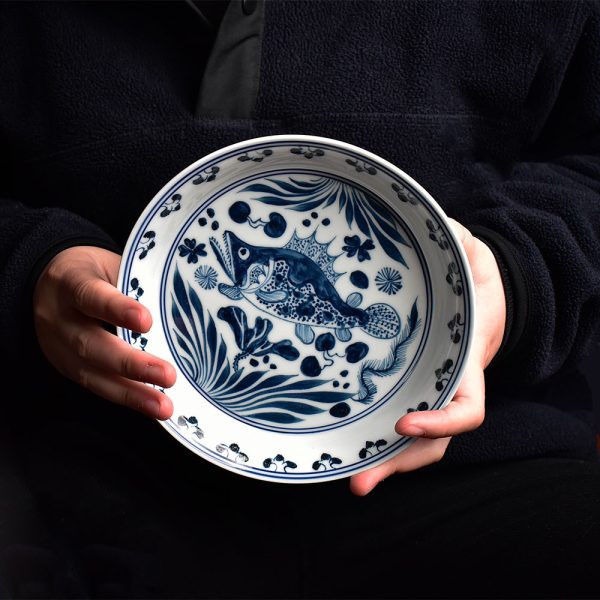
This Yuan-style blue and white fish-and-waterweed gaiwan is crafted using traditional Jingdezhen underglaze blue techniques. The body is sturdy, with a well-balanced form that exudes classical elegance. On the outer surface, vivid hand-painted carp swim gracefully among waving aquatic plants. The composition is lively and natural—the fish scales are delicately rendered, and the water plants sway in dynamic rhythm, revealing the artist’s refined brushwork and artistic finesse.
What sets this piece apart lies within: the interior of the gaiwan features an intricately incised design of fish and weeds, subtly hidden beneath the glaze. As light moves across the surface, the design gradually emerges like a submerged relief, as if the fish are gliding beneath the tea, adding a poetic and graceful charm to the tea experience.
The special pattern of this teacup is fish and seaweed. Since ancient times, fish and seaweed motifs have been traditional decorative patterns in ceramics, representing auspiciousness and carrying rich cultural and aesthetic meanings. The homophonic association between fish and the Chinese word for “surplus” (yu) makes fish a symbol of abundance and wealth. Fish motifs are often used to convey the meaning of “abundance and surplus,” “prosperity year after year” (as the pronunciation of fish is similar to that of “surplus” in Chinese), and “auspicious celebrations and abundance.” The fish and seaweed motifs typically feature fish as the central element, with additional decorations such as water plants, forming a variety of decorative patterns. The depiction of four swimming fish in the artwork symbolizes the concept of “surplus in all four seasons,” representing a year-round surplus, which carries a highly positive connotation. Such motifs are not only favoured by the royal court but also beloved by people from all walks of life as auspicious decorations. The flexible composition, auspicious symbolism, and abundant variations of fish and seaweed motifs have made them timeless classics throughout different eras.
For Yuan blue and white porcelain refers to the blue and white porcelain produced during the Yuan dynasty (1271-1368) in China. The Yuan dynasty was an important period in the history of Chinese porcelain and one of the peaks of Chinese porcelain art. As one of the representatives of that era, Yuan blue and white porcelain exhibited unique artistic styles and technical levels. The characteristic of Yuan blue and white is the use of cobalt blue pigment for painting, which is made of cobalt oxide. After firing, the colour is bright and rich, with extremely high decorative effect. Yuan blue and white porcelain has various shapes, thick and heavy, concise, and fluent lines, and stable and solemn shapes, all made exquisitely.
The evolution of Yuan blue and white is based on the foundation of Tang and Song celadon. Firstly, the glaze colour was improved and innovated. Unique white glaze, eggshell glaze and blue-white glaze were invented to make the glaze crystal clear. Cobalt pigment was imported for glaze colouring. Or using the pigment made from domestic materials.
The formation of tin spots on Yuan blue and white is due to the high content of iron elements in local parts of the blue pigment. After reaching saturation in the high-temperature glaze solution and cooling down, the iron elements in the supersaturated part start to precipitate. If the iron content of the blue pigment is higher and the cooling rate is appropriate, tin spots are more likely to appear on the surface of the ware.
In addition to firing and materials, the formation of tin spots also involves the factor of glaze material. During the painting process, tin spots can also be formed due to the accumulation of blue pigment. Tin spots are more likely to appear on the surface of the ware at the intersections and the starting and ending points of brushstrokes. The formation of tin spots can be said to be a natural creation or an artificial decoration.
This gaiwan has a thick body and uses the Su Ma Li Qing glaze material (a kind of blue pigment), with a heavy sense of tin spots, revealing a unique charm of the past era. The entire production process is completed by hand, and every detail has been carefully designed and polished, giving this teacup a unique artistic charm. The blue and white fish & seaweed pattern is vivid, showcasing ancient cultural and aesthetic values, allowing people to immerse themselves in a beautiful artistic atmosphere while enjoying their tea.
This teacup is made in the style of the Yuan dynasty blue and white porcelain, completely handmade and hand painted. The pattern of “一鹭莲科” or “一路连科” in Chinese culture is derived from the beautiful combination of the heron and lotus leaves. As “鹭” (heron) and “路” (path/road) have the same pronunciation, and “莲” (lotus) sounds like “连” (successive/continuous), the name “一路连科” is a play on words that conveys the beautiful meaning of the pattern. In ancient times, successive successful candidates in the imperial examinations were called “连科,” and “一路连科” is a good wish for students to have a smooth career path and achieve success step by step.
For Yuan blue and white porcelain refers to the blue and white porcelain produced during the Yuan dynasty (1271-1368) in China. The Yuan dynasty was an important period in the history of Chinese porcelain and one of the peaks of Chinese porcelain art. As one of the representatives of that era, Yuan blue and white porcelain exhibited unique artistic styles and technical levels. The characteristic of Yuan blue and white is the use of cobalt blue pigment for painting, which is made of cobalt oxide. After firing, the colour is bright and rich, with extremely high decorative effect. Yuan blue and white porcelain has various shapes, thick and heavy, concise, and fluent lines, and stable and solemn shapes, all made exquisitely.
The evolution of Yuan blue and white is based on the foundation of Tang and Song celadon. Firstly, the glaze colour was improved and innovated. Unique white glaze, eggshell glaze and blue-white glaze were invented to make the glaze crystal clear. Cobalt pigment was imported for glaze colouring. Or using the pigment made from domestic materials.
The formation of tin spots on Yuan blue and white is due to the high content of iron elements in local parts of the blue pigment. After reaching saturation in the high-temperature glaze solution and cooling down, the iron elements in the supersaturated part start to precipitate. If the iron content of the blue pigment is higher and the cooling rate is appropriate, tin spots are more likely to appear on the surface of the ware.
In addition to firing and materials, the formation of tin spots also involves the factor of glaze material. During the painting process, tin spots can also be formed due to the accumulation of blue pigment. Tin spots are more likely to appear on the surface of the ware at the intersections and the starting and ending points of brushstrokes. The formation of tin spots can be said to be a natural creation or an artificial decoration.
While this Lian Sheng Yuan Xi teacup retains the bold and rich coloration of classic Yuan blue and white porcelain, its tin-spot effect is relatively subtle, giving it a more delicate and refined appearance. The overall aesthetic is graceful and elegant, embodying a scholarly charm. Compared to the traditionally bold and unrestrained Yuan blue and white style, this piece leans towards a more understated and sophisticated aesthetic, blending classic heritage with a softer, more literary elegance. It brings a sense of warmth and refinement to any tea session, offering a harmonious balance between history and artistry.
This cover is fully hand-painted using the blue and white underglaze technology. It is an essential item for many people when brewing tea. It is used to hold teapot lids, Gaiwan lids, and cup lids. It not only keeps the lids of the teaware clean but also prevents them from wetting the tabletop.
Chanzhi Lian, also known as “Interlock Branch Lotus,” is a Chinese decorative motif with the symbolism of “flowers within flowers, blossoms within leaves.” It is also referred to as the “Wanshou Teng,” representing auspiciousness and longevity due to its continuous and interconnected structure, symbolizing the concept of “endless vitality.” In addition, in traditional Chinese Confucian culture, the lotus is seen as the embodiment of truth, goodness, and beauty, as well as a symbol of Buddhism. The pronunciation of “Lian” is similar to the word “continuous” in Chinese, further expressing the idea of continuous growth and conveying positive wishes and emotions.
As part of Chinese traditional ornamentation, Chanzhi Lian has been passed down through generations, reflecting its own beauty and cultural significance with a unique artistic charm. The lotus possesses a sacred and pure temperament, being beautiful without being ostentatious and magnificent without being vulgar. It is precisely because of this aesthetic appeal that Chanzhi Lian has become a decorative pattern applied to various aspects of life.
In this lid saucer, the delicate brushstrokes vividly outline the pattern, creating a glossy and elegant appearance. The colours are rich and vibrant, giving the piece a sense of vivid and liveliness.
Note: All are fully handmade, every lid saucer can be slightly different.
The style of this super beautiful teacup is Ming, using the underglaze blue technique, and entirely handcrafted and hand painted. The pattern features the classic design of intertwining lotus branches (Chanzhi Lian). What’s even more astonishing is the delicate craftsmanship of this teacup creates a thinness akin to cicada wings, a brilliance reminiscent of glass, and a weightless feel as floating clouds. When held up to the light, the intricately drawn interlocking lotus pattern inside the cup faintly emerges, elusive yet enchanting. It’s as if colorful clouds chase the moon, casting a misty glow, a sight so beautiful it’s beyond words, captivating, and mesmerizing.
The pattern of this beautiful teacup is Chanzhi Lian, which is also known as ‘intertwining lotus branches’ or ‘Interlock Branch Lotus’, which is a Chinese decorative motif with the symbolism of “flowers within flowers, blossoms within leaves.” It is also referred to as the “Wanshou Teng,” representing auspiciousness and longevity due to its continuous and interconnected structure, symbolizing the concept of “endless vitality.” In addition, in traditional Chinese Confucian culture, the lotus is seen as the embodiment of truth, goodness, and beauty, as well as a symbol of Buddhism. The pronunciation of “Lian” is similar to the word “continuous” in Chinese, further expressing the idea of continuous growth and conveying positive wishes and emotions.
As part of Chinese traditional ornamentation, Chanzhi Lian has been passed down through generations, reflecting its own beauty and cultural significance with a unique artistic charm. The lotus possesses a sacred and pure temperament, being beautiful without being ostentatious and magnificent without being vulgar. It is precisely because of this aesthetic appeal that Chanzhi Lian has become a decorative pattern applied to various aspects of life.
The Ruyi motifs on the outside of this teacup also carry auspicious meanings. The Ruyi symbolizes auspiciousness and good fortune. Its rounded and flawless form embodies blessings, satisfaction, and wishes fulfilled. Underneath its graceful appearance, it holds profound significance, representing the auspicious and delightful ideals of good fortune and contentment.
In addition, the beautiful tin spots on the porcelain add even more unique charm to it. The formation of tin spots is due to the high content of iron elements in local parts of the blue pigment. After reaching saturation in the high-temperature glaze solution and cooling down, the iron elements in the supersaturated part start to precipitate. If the iron content of the blue pigment is higher and the cooling rate is appropriate, tin spots are more likely to appear on the surface of the ware.
In addition to firing and materials, the formation of tin spots also involves the factor of glaze material. During the painting process, tin spots can also be formed due to the accumulation of blue pigment. Tin spots are more likely to appear on the surface of the ware at the intersections and the starting and ending points of brushstrokes. The formation of tin spots can be said to be a natural creation or an artificial decoration. These tin glazes not only add a rustic texture to the teacup but also imbue it with a unique sense of history.
The delicate brushstrokes and intricate detailing of the painting on this teacup create a distinct sense of aesthetic appeal. The stunning underglaze blue, along with the heavy tin glaze, gives it a bold and intense beauty. The thin-walled body also adds another layer of beauty to it. This teacup exudes a simple yet luxuriant charm, reminiscent of the style of imitation Ming, making it truly captivating and irresistible.
The style of this super beautiful Gaiwan is Ming, using the underglaze blue technique, and entirely handcrafted and hand painted. The pattern features the classic design of intertwining Peony branches.
Peony, one of the beloved traditional patterns in our country, holds a special place in the hearts of the Chinese people with its lush and vibrant appearance and striking colors. As a symbol of our national spirit, it embodies the beautiful aspirations and good wishes for life, symbolizing the prosperity and longevity of the Chinese nation, with a history that stretches far into the past. The intertwined peony, known as “Wanshou Teng” or “Peony with Entwined Branches,” is a traditional auspicious pattern, that represents joyous occasions. Its continuous interlocking structure also conveys the meaning of “endless vitality” or “continuous growth.”
In addition, the beautiful tin spots on the porcelain add even more unique charm to it. The formation of tin spots is due to the high content of iron elements in local parts of the blue pigment. After reaching saturation in the high-temperature glaze solution and cooling down, the iron elements in the supersaturated part start to precipitate. If the iron content of the blue pigment is higher and the cooling rate is appropriate, tin spots are more likely to appear on the surface of the ware.
In addition to firing and materials, the formation of tin spots also involves the factor of glaze material. During the painting process, tin spots can also be formed due to the accumulation of blue pigment. Tin spots are more likely to appear on the surface of the ware at the intersections and the starting and ending points of brushstrokes. The formation of tin spots can be said to be a natural creation or an artificial decoration. This tin glazes not only add a rustic texture to the Gaiwan but also imbue it with a unique sense of history.
This Gaiwan exudes a charming style reminiscent of imitating the essence of Yuan Dynasty tea sets.
This Gaiwan is completely handmade and hand-painted. The special craft used in this teaware includes Blue and white underglaze colour and underglaze red. The special horseshoe-shaped design allows for easy handling and prevents becoming too hot to touch.
The pattern featured is called “Bao Xiang” in Chinese, which is a traditional decorative motif representing one of the auspicious three treasures (Bao Xiang flower, Money tree, and Treasure basin), prevalent during the Sui and Tang dynasties in China. Bao Xiang pattern is also known as ‘Bao Xian Hua’ or ‘Bao Lian Hua’. Its lines are clear, and the colour is serene and antique. The Bao Xiang pattern design of this teaware is neat, and complex but not messy, and the whole picture of it is full and rich in details.
In Chinese culture, the Bao Xiang pattern symbolizes auspiciousness and happiness, representing people’s aspirations for happiness. It is widely popular in the decoration of silk brocade, bronze mirrors, and porcelain, showcasing people’s pursuit of a better life.
This Gaiwan features smooth and concise curves, combining the unique beauty of the Bao Xiang pattern, creating a visually appealing and enjoyable tea-drinking experience. The blue and red underglaze colours complement each other and create a beautiful radiance.
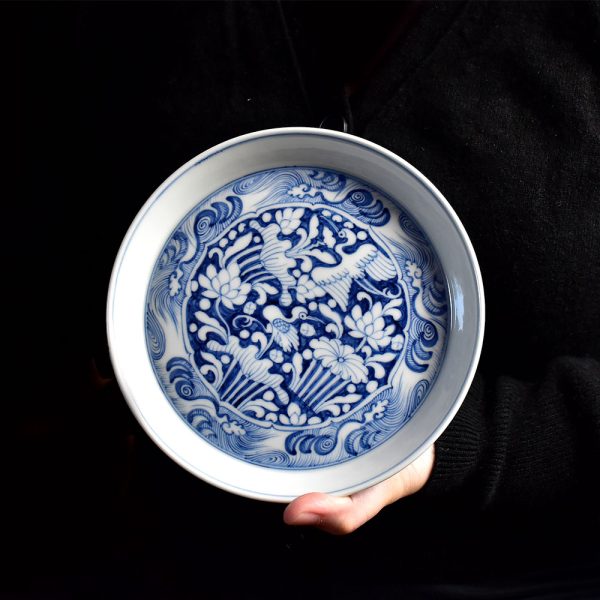
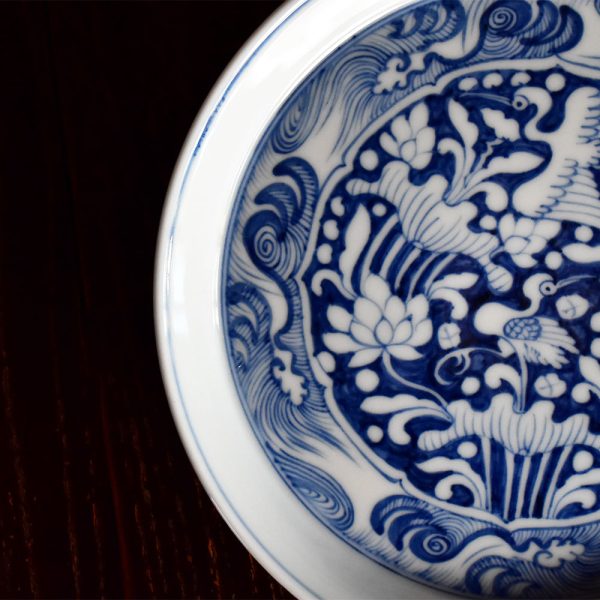
This tea tray is completely handmade and hand-painted. The pattern featured is called “Bao Xiang” in Chinese, which is a traditional decorative motif representing one of the auspicious three treasures (Bao Xiang flower, Money tree, and Treasure basin), prevalent during the Sui and Tang dynasties in China. Bao Xiang pattern is also known as ‘Bao Xian Hua’ or ‘Bao Lian Hua’. Its lines are clear, and the colour is serene and antique. The Bao Xiang pattern design of this teaware is neat, and complex but not messy, and the whole picture of it is full and rich in details.
In Chinese culture, the Bao Xiang pattern symbolizes auspiciousness and happiness, representing people’s aspirations for happiness. It is widely popular in the decoration of silk brocade, bronze mirrors, and porcelain, showcasing people’s pursuit of a better life.
This tea tray features smooth and concise curves, combining the unique beauty of the Bao Xiang pattern, creating a visually appealing and enjoyable tea-drinking experience.
This Gaiwan is completely handmade and hand-painted. The pattern featured is called “Bao Xiang” in Chinese, which is a traditional decorative motif representing one of the auspicious three treasures (Bao Xiang flower, Money tree, and Treasure basin), prevalent during the Sui and Tang dynasties in China. Bao Xiang pattern is also known as ‘Bao Xian Hua’ or ‘Bao Lian Hua’. Its lines are clear, and the colour is serene and antique. The Bao Xiang pattern design of this teaware is neat, and complex but not messy, and the whole picture of it is full and rich in details.
In Chinese culture, the Bao Xiang pattern symbolizes auspiciousness and happiness, representing people’s aspirations for happiness. It is widely popular in the decoration of silk brocade, bronze mirrors, and porcelain, showcasing people’s pursuit of a better life.
This Gaiwan features smooth and concise curves, combining the unique beauty of the Bao Xiang pattern, creating a visually appealing and enjoyable tea-drinking experience.
The style of this super beautiful Gaiwan is Ming, using the underglaze blue technique, and entirely handcrafted and hand painted. The pattern features the classic design of intertwining lotus branches (Chanzhi Lian).
Chanzhi Lian, also known as ‘intertwining lotus branches’ or ‘Interlock Branch Lotus’, is a Chinese decorative motif with the symbolism of “flowers within flowers, blossoms within leaves.” It is also referred to as the “Wanshou Teng,” representing auspiciousness and longevity due to its continuous and interconnected structure, symbolizing the concept of “endless vitality.” In addition, in traditional Chinese Confucian culture, the lotus is seen as the embodiment of truth, goodness, and beauty, as well as a symbol of Buddhism. The pronunciation of “Lian” is similar to the word “continuous” in Chinese, further expressing the idea of continuous growth and conveying positive wishes and emotions.
As part of Chinese traditional ornamentation, Chanzhi Lian has been passed down through generations, reflecting its own beauty and cultural significance with a unique artistic charm. The lotus possesses a sacred and pure temperament, being beautiful without being ostentatious and magnificent without being vulgar. It is precisely because of this aesthetic appeal that Chanzhi Lian has become a decorative pattern applied to various aspects of life.
The Ruyi motifs on the outside of this flat-bottom Gaiwan also carry auspicious meanings. The Ruyi symbolizes auspiciousness and good fortune. Its rounded and flawless form embodies blessings, satisfaction, and wishes fulfilled. Underneath its graceful appearance, it holds profound significance, representing the auspicious and delightful ideals of good fortune and contentment.
In addition, the beautiful tin spots on the porcelain add even more unique charm to it. The formation of tin spots is due to the high content of iron elements in local parts of the blue pigment. After reaching saturation in the high-temperature glaze solution and cooling down, the iron elements in the supersaturated part start to precipitate. If the iron content of the blue pigment is higher and the cooling rate is appropriate, tin spots are more likely to appear on the surface of the ware.
In addition to firing and materials, the formation of tin spots also involves the factor of glaze material. During the painting process, tin spots can also be formed due to the accumulation of blue pigment. Tin spots are more likely to appear on the surface of the ware at the intersections and the starting and ending points of brushstrokes. The formation of tin spots can be said to be a natural creation or an artificial decoration. This tin glazes not only add a rustic texture to the Gaiwan but also imbue it with a unique sense of history.
The delicate brushstrokes and intricate detailing of the painting on this Gaiwan create a distinct sense of aesthetic appeal. The stunning underglaze blue, along with the heavy tin glaze, gives it a bold and intense beauty. This Gaiwan exudes a simple yet luxuriant charm, reminiscent of the style of imitation Ming, making it truly captivating and irresistible.
The style of this super beautiful Gaiwan is Ming, using the underglaze blue technique, and entirely handcrafted and hand painted. The pattern features the classic design of intertwining lotus branches (Chanzhi Lian).
Chanzhi Lian, also known as ‘intertwining lotus branches’ or ‘Interlock Branch Lotus’, is a Chinese decorative motif with the symbolism of “flowers within flowers, blossoms within leaves.” It is also referred to as the “Wanshou Teng,” representing auspiciousness and longevity due to its continuous and interconnected structure, symbolizing the concept of “endless vitality.” In addition, in traditional Chinese Confucian culture, the lotus is seen as the embodiment of truth, goodness, and beauty, as well as a symbol of Buddhism. The pronunciation of “Lian” is similar to the word “continuous” in Chinese, further expressing the idea of continuous growth and conveying positive wishes and emotions.
As part of Chinese traditional ornamentation, Chanzhi Lian has been passed down through generations, reflecting its own beauty and cultural significance with a unique artistic charm. The lotus possesses a sacred and pure temperament, being beautiful without being ostentatious and magnificent without being vulgar. It is precisely because of this aesthetic appeal that Chanzhi Lian has become a decorative pattern applied to various aspects of life.
In addition, the beautiful tin spots on the porcelain add even more unique charm to it. The formation of tin spots is due to the high content of iron elements in local parts of the blue pigment. After reaching saturation in the high-temperature glaze solution and cooling down, the iron elements in the supersaturated part start to precipitate. If the iron content of the blue pigment is higher and the cooling rate is appropriate, tin spots are more likely to appear on the surface of the ware.
In addition to firing and materials, the formation of tin spots also involves the factor of glaze material. During the painting process, tin spots can also be formed due to the accumulation of blue pigment. Tin spots are more likely to appear on the surface of the ware at the intersections and the starting and ending points of brushstrokes. The formation of tin spots can be said to be a natural creation or an artificial decoration. This tin glazes not only add a rustic texture to the Gaiwan but also imbue it with a unique sense of history.
The delicate brushstrokes and intricate detailing of the painting on this Gaiwan create a distinct sense of aesthetic appeal. The soft and elegant shade of underglaze blue, along with a hint of faint tin glaze, gives it a graceful and ethereal beauty under the light. This Gaiwan exudes a simple yet elegant charm, reminiscent of the style of imitation Ming, making it truly captivating and irresistible.
The style of this super beautiful Gaiwan is Ming, using the underglaze blue technique, and entirely handcrafted and hand painted. The pattern on the lid features a classic design of intertwining lotus branches (known as Chanzhi Lian), while the pattern on the body of Gaiwan showcases the traditional Chinese twin lotus motif. The design of the tall style with an outward-flared mouth extends the curvature of the Gaiwan, making it less likely to scald one’s hand during use. The short style, on the other hand, is delicate and compact, with a thicker body, suitable for tea drinkers with smaller hands.
In ancient China, the twin lotus due to its symbolic meaning is regarded as the gentleman among flowers. It represents the finest specimen among lotus flowers and symbolises a harmonious and everlasting union. The twin lotus, with one stem and two blooms, epitomizes the notion of unity, shared roots, shared blessings, and shared existence. Besides that, in ancient literary works, the twin lotus is acclaimed as a symbol of love, conveying the message of marital harmony, happiness, and representing the tender affection between lovers. It is also associated with deep brotherly love, signifying profound emotional bonds between siblings. In folklore, the appearance of twin lotus is considered an auspicious sign of good fortune.
In addition, the beautiful tin spots on the porcelain add even more unique charm to it. The formation of tin spots is due to the high content of iron elements in local parts of the blue pigment. After reaching saturation in the high-temperature glaze solution and cooling down, the iron elements in the supersaturated part start to precipitate. If the iron content of the blue pigment is higher and the cooling rate is appropriate, tin spots are more likely to appear on the surface of the ware.
In addition to firing and materials, the formation of tin spots also involves the factor of glaze material. During the painting process, tin spots can also be formed due to the accumulation of blue pigment. Tin spots are more likely to appear on the surface of the ware at the intersections and the starting and ending points of brushstrokes. The formation of tin spots can be said to be a natural creation or an artificial decoration. This tin glazes not only add a rustic texture to the Gaiwan but also imbue it with a unique sense of history.
The delicate brushstrokes and intricate detailing of the painting on this Gaiwan create a distinct sense of aesthetic appeal. The soft and elegant shade of underglaze blue, along with a hint of faint tin glaze, gives it a graceful and ethereal beauty under the light. This Gaiwan exudes a simple yet elegant charm, reminiscent of the style of imitation Ming, making it truly captivating and irresistible.
The style of this super beautiful Gaiwan is Ming, using the underglaze blue technique, and entirely handcrafted and hand painted. The pattern on the lid features a classic design of intertwining lotus branches (known as Chanzhi Lian), while the pattern on the body of Gaiwan showcases the traditional Chinese twin lotus motif. The design of the tall style with an outward-flared mouth extends the curvature of the Gaiwan, making it less likely to scald one’s hand during use. The short style, on the other hand, is delicate and compact, with a thicker body, suitable for tea drinkers with smaller hands.
In ancient China, the twin lotus due to its symbolic meaning is regarded as the gentleman among flowers. It represents the finest specimen among lotus flowers and symbolises a harmonious and everlasting union. The twin lotus, with one stem and two blooms, epitomizes the notion of unity, shared roots, shared blessings, and shared existence. Besides that, in ancient literary works, the twin lotus is acclaimed as a symbol of love, conveying the message of marital harmony, happiness, and representing the tender affection between lovers. It is also associated with deep brotherly love, signifying profound emotional bonds between siblings. In folklore, the appearance of twin lotus is considered an auspicious sign of good fortune.
In addition, the beautiful tin spots on the porcelain add even more unique charm to it. The formation of tin spots is due to the high content of iron elements in local parts of the blue pigment. After reaching saturation in the high-temperature glaze solution and cooling down, the iron elements in the supersaturated part start to precipitate. If the iron content of the blue pigment is higher and the cooling rate is appropriate, tin spots are more likely to appear on the surface of the ware.
In addition to firing and materials, the formation of tin spots also involves the factor of glaze material. During the painting process, tin spots can also be formed due to the accumulation of blue pigment. Tin spots are more likely to appear on the surface of the ware at the intersections and the starting and ending points of brushstrokes. The formation of tin spots can be said to be a natural creation or an artificial decoration. This tin glazes not only add a rustic texture to the Gaiwan but also imbue it with a unique sense of history.
The delicate brushstrokes and intricate detailing of the painting on this Gaiwan create a distinct sense of aesthetic appeal. The soft and elegant shade of underglaze blue, along with a hint of faint tin glaze, gives it a graceful and ethereal beauty under the light. This Gaiwan exudes a simple yet elegant charm, reminiscent of the style of imitation Ming, making it truly captivating and irresistible.
This charming Gaiwan is using blue and white porcelain craftsmanship, made entirely by hand.
One of the patterns depicts a pair of phoenixes. The phoenix, known as the “Fenghuang” in Chinese, is a mythical bird considered to be the king of all birds and a symbol of auspiciousness, beauty, and grace. It represents virtue, harmony, and the union of yin and yang. When depicted as a pair, the double phoenix symbolizes the ideal relationship between a male and a female. It represents the union of two exceptional individuals or the coming together of two extraordinary things. It signifies a harmonious and balanced partnership, whether in love, marriage, or any collaborative endeavour. The double phoenix is often associated with blessings, prosperity, and good fortune. It is believed to bring luck, happiness, and success, as well as symbolize marital bliss, loyalty, and everlasting love.
Another pattern used on this Gaiwan is Chanzhi Lian. Chanzhi Lian, also known as “Interlock Branch Lotus,” is a Chinese decorative motif with the symbolism of “flowers within flowers, blossoms within leaves.” It is also referred to as the “Wanshou Teng,” representing auspiciousness and longevity due to its continuous and interconnected structure, symbolizing the concept of “endless vitality.” In addition, in traditional Chinese Confucian culture, the lotus is seen as the embodiment of truth, goodness, and beauty, as well as a symbol of Buddhism. The pronunciation of “Lian” is similar to the word “continuous” in Chinese, further expressing the idea of continuous growth and conveying positive wishes and emotions.
As part of Chinese traditional ornamentation, Chanzhi Lian has been passed down through generations, reflecting its own beauty and cultural significance with a unique artistic charm. The lotus possesses a sacred and pure temperament, being beautiful without being ostentatious and magnificent without being vulgar. It is precisely because of this aesthetic appeal that Chanzhi Lian has become a decorative pattern applied to various aspects of life.
The texture of this Gaiwan is delicate and smooth, and the painting is lively and lifelike. The entire production process is completed by hand, with every detail carefully designed and polished, giving this Gaiwan a unique artistic charm. This tea ware by imitating the shape and style of traditional Chinese tea ware, allowing people to appreciate the charm of traditional art and experience the flavour of history. The elegant lines, smooth curves, and delicate decorations present a sense of refined and harmonious beauty, allowing people to experience pleasure and artistic enjoyment while tasting tea.
This Gaiwan is made in the style of the Yuan dynasty blue and white porcelain, completely handmade and hand-painted. The pattern of “一鹭莲科” or “一路连科” in Chinese culture is derived from the beautiful combination of the heron and lotus leaves. As “鹭” (heron) and “路” (path/road) have the same pronunciation, and “莲” (lotus) sounds like “连” (successive/continuous), the name “一路连科” is a play on words that conveys the beautiful meaning of the pattern. In ancient times, successive successful candidates in the imperial examinations were called “连科,” and “一路连科” is a good wish for students to have a smooth career path and achieve success step by step.
For Yuan blue and white porcelain refers to the blue and white porcelain produced during the Yuan dynasty (1271-1368) in China. The Yuan dynasty was an important period in the history of Chinese porcelain and one of the peaks of Chinese porcelain art. As one of the representatives of that era, Yuan blue and white porcelain exhibited unique artistic styles and technical levels. The characteristic of Yuan blue and white is the use of cobalt blue pigment for painting, which is made of cobalt oxide. After firing, the colour is bright and rich, with an extremely high decorative effect. Yuan blue and white porcelain has various shapes, thick and heavy, concise, and fluent lines, and stable and solemn shapes, all made exquisitely.
The evolution of Yuan blue and white is based on the foundation of the Tang and Song celadon. Firstly, the glaze colour was improved and innovated. Unique white glaze, eggshell glaze and blue-white glaze were invented to make the glaze crystal clear. Cobalt pigment was imported for glaze colouring. Or using pigment made from domestic materials.
The formation of tin spots on Yuan blue and white is due to the high content of iron elements in local parts of the blue pigment. After reaching saturation in the high-temperature glaze solution and cooling down, the iron elements in the supersaturated part start to precipitate. If the iron content of the blue pigment is higher and the cooling rate is appropriate, tin spots are more likely to appear on the surface of the ware.
In addition to firing and materials, the formation of tin spots also involves the factor of glaze material. During the painting process, tin spots can also be formed due to the accumulation of blue pigment. Tin spots are more likely to appear on the surface of the ware at the intersections and the starting and ending points of brushstrokes. The formation of tin spots can be said to be a natural creation or an artificial decoration.
This Gaiwan has a thick body and uses the Su Ma Li Qing glaze material (a kind of blue pigment), with a heavy sense of tin spots, revealing a unique charm of the past era. The entire production process is completed by hand, and every detail has been carefully designed and polished, giving this Gaiwan a unique artistic charm.
This tea set is completely handmade and hand-painted. The pattern featured is called “Bao Xiang” in Chinese, which is a traditional decorative motif representing one of the auspicious three treasures (Bao Xiang flower, Money tree, and Treasure basin), prevalent during the Sui and Tang dynasties in China. Bao Xiang pattern is also known as ‘Bao Xian Hua’ or ‘Bao Lian Hua’. Its lines are clear, and the colour is serene and antique. The Bao Xiang pattern design of this teaware is neat, and complex but not messy, and the whole picture of it is full and rich in details.
In Chinese culture, the Bao Xiang pattern symbolizes auspiciousness and happiness, representing people’s aspirations for happiness. It is widely popular in the decoration of silk brocade, bronze mirrors, and porcelain, showcasing people’s pursuit of a better life.
This tea set features smooth and concise curves, combining the unique beauty of the Bao Xiang pattern, creating a visually appealing and enjoyable tea-drinking experience.
The style of this super beautiful teacup is Ming, using the underglaze blue technique, and entirely handcrafted and hand painted.
This cup is adorned with intricate blue and white patterns of interwoven branches and miscellaneous treasures (Za Bao in Chinese) on the outer wall, with a lotus petal pattern encircling the base. The interior of the cup is fully covered in blue and white patterns of Baoxiang flowers and Ruyi motifs, creating an overall design that is rich and detailed, with smooth and flowing lines. The blue and white colours are deep and elegant, with a white glaze featuring subtle flashes of blue. The glaze surface is glossy, and the texture is smooth. The cup has a lightweight and elegant shape, achieving a harmonious balance between practicality and aesthetics. At the bottom, there is a chicken-heart-shaped protrusion, hence the name ‘chicken-heart teacup’.
In ancient China, the intertwined branch pattern represented the concept of endless growth and lasting wealth and prosperity, symbolizing longevity, and prosperity. And the miscellaneous treasures (Za Bao in Chinese) pattern symbolizes various decorative motifs that bring good luck and auspiciousness. Due to the absence of a fixed number and combination of elements, it is commonly known as the “miscellaneous treasures” pattern. The miscellaneous treasures pattern encompasses the common aspirations of society for power, wealth, love, happiness, longevity, and pleasure, making it a popular and cherished design in folk art.
The Baoxiang flowers inside the cup symbolize good luck, harmony, happiness, and prosperity. The Ruyi motif’s auspiciousness, combining profound meaning with graceful form, represents the auspicious, favourable implications.
In addition, the beautiful tin spots on the porcelain add even more unique charm to it. The formation of tin spots is due to the high content of iron elements in local parts of the blue pigment. After reaching saturation in the high-temperature glaze solution and cooling down, the iron elements in the supersaturated part start to precipitate. If the iron content of the blue pigment is higher and the cooling rate is appropriate, tin spots are more likely to appear on the surface of the ware.
In addition to firing and materials, the formation of tin spots also involves the factor of glaze material. During the painting process, tin spots can also be formed due to the accumulation of blue pigment. Tin spots are more likely to appear on the surface of the ware at the intersections and the starting and ending points of brushstrokes. The formation of tin spots can be said to be a natural creation or an artificial decoration. This tin glazes not only add a rustic texture to the teacup but also imbue it with a unique sense of history.
The body of this teacup is smooth and well-lubricated, while the underglaze blue patterns are vivid and lifelike. The faint tin specks add a touch of charm from a bygone era, evoking a sense of nostalgia and natural beauty, making it exquisitely graceful. Each stroke of the underglaze blue decoration is delicate and captivating, bringing the design to life. The intricate and refined patterns showcase the artist’s profound artistic skills.
The style of this super beautiful teacup is Ming, using the underglaze blue technique, and entirely handcrafted and hand painted. The pattern features the classic design of intertwining lotus branches (Chanzhi Lian).
Chanzhi Lian, also known as ‘intertwining lotus branches’ or ‘Interlock Branch Lotus’, is a Chinese decorative motif with the symbolism of “flowers within flowers, blossoms within leaves.” It is also referred to as the “Wanshou Teng,” representing auspiciousness and longevity due to its continuous and interconnected structure, symbolizing the concept of “endless vitality.” In addition, in traditional Chinese Confucian culture, the lotus is seen as the embodiment of truth, goodness, and beauty, as well as a symbol of Buddhism. The pronunciation of “Lian” is similar to the word “continuous” in Chinese, further expressing the idea of continuous growth and conveying positive wishes and emotions.
As part of Chinese traditional ornamentation, Chanzhi Lian has been passed down through generations, reflecting its own beauty and cultural significance with a unique artistic charm. The lotus possesses a sacred and pure temperament, being beautiful without being ostentatious and magnificent without being vulgar. It is precisely because of this aesthetic appeal that Chanzhi Lian has become a decorative pattern applied to various aspects of life.
In addition, the beautiful tin spots on the porcelain add even more unique charm to it. The formation of tin spots is due to the high content of iron elements in local parts of the blue pigment. After reaching saturation in the high-temperature glaze solution and cooling down, the iron elements in the supersaturated part start to precipitate. If the iron content of the blue pigment is higher and the cooling rate is appropriate, tin spots are more likely to appear on the surface of the ware.
In addition to firing and materials, the formation of tin spots also involves the factor of glaze material. During the painting process, tin spots can also be formed due to the accumulation of blue pigment. Tin spots are more likely to appear on the surface of the ware at the intersections and the starting and ending points of brushstrokes. The formation of tin spots can be said to be a natural creation or an artificial decoration. This tin glazes not only add a rustic texture to the teacup but also imbue it with a unique sense of history.
The delicate brushstrokes and intricate detailing of the painting on this teacup create a distinct sense of aesthetic appeal. The soft and elegant shade of underglaze blue, along with a hint of faint tin glaze, gives it a graceful and ethereal beauty under the light. This teacup exudes a simple yet elegant charm, reminiscent of the style of imitation Ming, making it truly captivating and irresistible.
The style of this super beautiful teacup is Ming, using the underglaze blue technique, and entirely handcrafted and hand painted. The pattern on the body of the teacup showcases the traditional Chinese twin lotus motif.
In addition, the beautiful tin spots on the porcelain add even more unique charm to it. The formation of tin spots is due to the high content of iron elements in local parts of the blue pigment. After reaching saturation in the high-temperature glaze solution and cooling down, the iron elements in the supersaturated part start to precipitate. If the iron content of the blue pigment is higher and the cooling rate is appropriate, tin spots are more likely to appear on the surface of the ware.
In addition to firing and materials, the formation of tin spots also involves the factor of glaze material. During the painting process, tin spots can also be formed due to the accumulation of blue pigment. Tin spots are more likely to appear on the surface of the ware at the intersections and the starting and ending points of brushstrokes. The formation of tin spots can be said to be a natural creation or an artificial decoration. This tin glazes not only add a rustic texture to the teacup but also imbue it with a unique sense of history.
The delicate brushstrokes and intricate detailing of the painting on this teacup create a distinct sense of aesthetic appeal. The soft and elegant shade of underglaze blue, along with a hint of faint tin glaze, gives it a graceful and ethereal beauty under the light. This teacup exudes a simple yet elegant charm, reminiscent of the style of imitation Ming, making it truly captivating and irresistible.
This master teacup is made in the style of the Yuan dynasty blue and white porcelain, completely handmade and hand-painted. The entire painting exudes a strong sense of antiquity, with bold and vigorous lines, and the dragon pattern appears vivid and lifelike.
In Chinese culture, the dragon is a very important symbol and totem with rich symbolism. Firstly, the dragon is one of the most sacred, authoritative, and noble images in ancient Chinese culture. It is the incarnation of the gods of heaven, earth, and water, representing supreme authority and divine power. Secondly, the dragon is considered a symbol of good luck in Chinese culture. As it has the special power to control rainfall, it is also seen as the protector of agriculture, representing a bountiful harvest and prosperity. Additionally, the dragon has many other symbolic meanings, such as longevity, authority, success, courage, and wisdom. In traditional Chinese culture, the dragon is a noble, mysterious, and awe-inspiring image, representing people’s yearning for the unknown and the spirit of exploration.
Besides, for Yuan blue and white porcelain refers to the blue and white porcelain produced during the Yuan dynasty (1271-1368) in China. The Yuan dynasty was an important period in the history of Chinese porcelain and one of the peaks of Chinese porcelain art. As one of the representatives of that era, Yuan blue and white porcelain exhibited unique artistic styles and technical levels. The characteristic of Yuan blue and white is the use of cobalt blue pigment for painting, which is made of cobalt oxide. After firing, the colour is bright and rich, with an extremely high decorative effect. Yuan blue and white porcelain has various shapes, thick and heavy, concise, and fluent lines, and stable and solemn shapes, all made exquisitely.
The evolution of Yuan blue and white is based on the foundation of the Tang and Song celadon. Firstly, the glaze colour was improved and innovated. Unique white glaze, eggshell glaze, and blue-white glaze were invented to make the glaze crystal clear. Cobalt pigment was imported for glaze colouring. Or using pigment made from domestic materials.
The formation of tin spots on Yuan blue and white is due to the high content of iron elements in local parts of the blue pigment. After reaching saturation in the high-temperature glaze solution and cooling down, the iron elements in the supersaturated part start to precipitate. If the iron content of the blue pigment is higher and the cooling rate is appropriate, tin spots are more likely to appear on the surface of the ware.
In addition to firing and materials, the formation of tin spots also involves the factor of glaze material. During the painting process, tin spots can also be formed due to the accumulation of blue pigment. Tin spots are more likely to appear on the surface of the ware at the intersections and the starting and ending points of brushstrokes. The formation of tin spots can be said to be a natural creation or an artificial decoration.
This master teacup has a smooth and lustrous texture and uses the Su Ma Li Qing glaze material (a kind of blue pigment), with a heavy sense of tin spots, revealing a unique charm of the past era. The entire production process is completed by hand, and every detail has been carefully designed and polished, giving this teacup a unique artistic charm. The blue and white dragon pattern is vivid, showcasing ancient cultural and aesthetic values, allowing people to immerse themselves in a beautiful artistic atmosphere while enjoying their tea.
This arhat teacup is made in the style of the Yuan dynasty blue and white porcelain, completely handmade and hand painted. The pattern of “一鹭莲科” or “一路连科” in Chinese culture is derived from the beautiful combination of the heron and lotus leaves. As “鹭” (heron) and “路” (path/road) have the same pronunciation, and “莲” (lotus) sounds like “连” (successive/continuous), the name “一路连科” is a play on words that conveys the beautiful meaning of the pattern. In ancient times, successive successful candidates in the imperial examinations were called “连科,” and “一路连科” is a good wish for students to have a smooth career path and achieve success step by step.
This teacup has a thick body and uses the Su Ma Li Qing glaze material (a kind of blue pigment) which reveals a unique charm of the past era. The entire production process is completed by hand, and every detail has been carefully designed and polished, giving this teacup a unique artistic charm.
In Chinese culture, the dragon is a very important symbol and totem with rich symbolism. Firstly, the dragon is one of the most sacred, authoritative, and noble images in ancient Chinese culture. It is the incarnation of the gods of heaven, earth, and water, representing supreme authority and divine power. Secondly, the dragon is considered a symbol of good luck in Chinese culture. As it has the special power to control rainfall, it is also seen as the protector of agriculture, representing a bountiful harvest and prosperity. Additionally, the dragon has many other symbolic meanings, such as longevity, authority, success, courage, and wisdom. In traditional Chinese culture, the dragon is a noble, mysterious, and awe-inspiring image, representing people’s yearning for the unknown and the spirit of exploration.
This fair cup is made in the style of the Yuan dynasty blue and white porcelain, completely handmade and hand-painted. The blue and white dragon pattern is vivid, showcasing ancient cultural and aesthetic values, allowing people to immerse themselves in a beautiful artistic atmosphere while enjoying their tea.
For Yuan blue and white porcelain refers to the blue and white porcelain produced during the Yuan dynasty (1271-1368) in China. The Yuan dynasty was an important period in the history of Chinese porcelain and one of the peaks of Chinese porcelain art. As one of the representatives of that era, Yuan blue and white porcelain exhibited unique artistic styles and technical levels. The characteristic of Yuan blue and white is the use of cobalt blue pigment for painting, which is made of cobalt oxide. After firing, the colour is bright and rich, with an extremely high decorative effect. Yuan blue and white porcelain has various shapes, thick and heavy, concise, and fluent lines, and stable and solemn shapes, all made exquisitely.
The evolution of Yuan blue and white is based on the foundation of the Tang and Song celadon. Firstly, the glaze colour was improved and innovated. Unique white glaze, eggshell glaze, and blue-white glaze were invented to make the glaze crystal clear. Cobalt pigment was imported for glaze colouring. Or using pigment made from domestic materials.
The formation of tin spots on Yuan blue and white is due to the high content of iron elements in local parts of the blue pigment. After reaching saturation in the high-temperature glaze solution and cooling down, the iron elements in the supersaturated part start to precipitate. If the iron content of the blue pigment is higher and the cooling rate is appropriate, tin spots are more likely to appear on the surface of the ware.
In addition to firing and materials, the formation of tin spots also involves the factor of glaze material. During the painting process, tin spots can also be formed due to the accumulation of blue pigment. Tin spots are more likely to appear on the surface of the ware at the intersections and the starting and ending points of brushstrokes. The formation of tin spots can be said to be a natural creation or an artificial decoration.
This fair cup has a thick body and uses the Su Ma Li Qing glaze material (a kind of blue pigment), with a heavy sense of tin spots, revealing a unique charm of the past era. The entire production process is completed by hand, and every detail has been carefully designed and polished, giving this teacup a unique artistic charm. The blue and white dragon pattern is vivid, showcasing ancient cultural and aesthetic values, allowing people to immerse themselves in a beautiful artistic atmosphere while enjoying their tea.
This fair cup is made in the style of the Yuan dynasty blue and white porcelain, completely handmade and hand-painted. The blue and white fish & seaweed pattern is vivid, showcasing ancient cultural and aesthetic values, allowing people to immerse themselves in a beautiful artistic atmosphere while enjoying their tea.
The special pattern of this teacup is fish and seaweed. Since ancient times, fish and seaweed motifs have been traditional decorative patterns in ceramics, representing auspiciousness and carrying rich cultural and aesthetic meanings. The homophonic association between fish and the Chinese word for “surplus” (yu) makes fish a symbol of abundance and wealth. Fish motifs are often used to convey the meaning of “abundance and surplus,” “prosperity year after year” (as the pronunciation of fish is similar to that of “surplus” in Chinese), and “auspicious celebrations and abundance.” The fish and seaweed motifs typically feature fish as the central element, with additional decorations such as water plants, forming a variety of decorative patterns. The depiction of four swimming fish in the artwork symbolizes the concept of “surplus in all four seasons,” representing a year-round surplus, which carries a highly positive connotation. Such motifs are not only favoured by the royal court but also beloved by people from all walks of life as auspicious decorations. The flexible composition, auspicious symbolism, and abundant variations of fish and seaweed motifs have made them timeless classics throughout different eras.
For Yuan blue and white porcelain refers to the blue and white porcelain produced during the Yuan dynasty (1271-1368) in China. The Yuan dynasty was an important period in the history of Chinese porcelain and one of the peaks of Chinese porcelain art. As one of the representatives of that era, Yuan blue and white porcelain exhibited unique artistic styles and technical levels. The characteristic of Yuan blue and white is the use of cobalt blue pigment for painting, which is made of cobalt oxide. After firing, the colour is bright and rich, with an extremely high decorative effect. Yuan blue and white porcelain has various shapes, thick and heavy, concise, and fluent lines, and stable and solemn shapes, all made exquisitely.
The evolution of Yuan blue and white is based on the foundation of the Tang and Song celadon. Firstly, the glaze colour was improved and innovated. Unique white glaze, eggshell glaze and blue-white glaze were invented to make the glaze crystal clear. Cobalt pigment was imported for glaze colouring. Or using pigment made from domestic materials.
The formation of tin spots on Yuan blue and white is due to the high content of iron elements in local parts of the blue pigment. After reaching saturation in the high-temperature glaze solution and cooling down, the iron elements in the supersaturated part start to precipitate. If the iron content of the blue pigment is higher and the cooling rate is appropriate, tin spots are more likely to appear on the surface of the ware.
In addition to firing and materials, the formation of tin spots also involves the factor of glaze material. During the painting process, tin spots can also be formed due to the accumulation of blue pigment. Tin spots are more likely to appear on the surface of the ware at the intersections and the starting and ending points of brushstrokes. The formation of tin spots can be said to be a natural creation or an artificial decoration.
This fair cup has a thick body and uses the Su Ma Li Qing glaze material (a kind of blue pigment), with a heavy sense of tin spots, revealing a unique charm of the past era. The entire production process is completed by hand, and every detail has been carefully designed and polished, giving this teacup a unique artistic charm. The blue and white fish & seaweed pattern is vivid, showcasing ancient cultural and aesthetic values, allowing people to immerse themselves in a beautiful artistic atmosphere while enjoying their tea.
This heart shaped teacup is completely handmade, and hand painted. The special craft used in this teaware includes Blue and white underglaze colour and underglaze red.
The pattern featured is called “Bao Xiang” in Chinese, which is a traditional decorative motif representing one of the auspicious three treasures (Bao Xiang flower, Money tree, and Treasure basin), prevalent during the Sui and Tang dynasties in China. Bao Xiang pattern is also known as ‘Bao Xian Hua’ or ‘Bao Lian Hua’. Its lines are clear, and the colour is serene and antique. The Bao Xiang pattern design of this teaware is neat, and complex but not messy, and the whole picture of it is full and rich in details.
In Chinese culture, the Bao Xiang pattern symbolizes auspiciousness and happiness, representing people’s aspirations for happiness. It is widely popular in the decoration of silk brocade, bronze mirrors, and porcelain, showcasing people’s pursuit of a better life.
This heart shaped teacup features smooth and concise curves, combining the unique beauty of Bao Xiang pattern, creating a visually appealing and enjoyable tea-drinking experience. The blue and red underglaze colours complement each other and create a beautiful radiance.
This teacup is made in the style of the Yuan dynasty blue and white porcelain, completely handmade and hand painted. The blue and white fish & seaweed pattern is vivid, showcasing ancient cultural and aesthetic values, allowing people to immerse themselves in a beautiful artistic atmosphere while enjoying their tea.
The special pattern of this teacup is fish and seaweed. Since ancient times, fish and seaweed motifs have been traditional decorative patterns in ceramics, representing auspiciousness and carrying rich cultural and aesthetic meanings. The homophonic association between fish and the Chinese word for “surplus” (yu) makes fish a symbol of abundance and wealth. Fish motifs are often used to convey the meaning of “abundance and surplus,” “prosperity year after year” (as the pronunciation of fish is similar to that of “surplus” in Chinese), and “auspicious celebrations and abundance.” The fish and seaweed motifs typically feature fish as the central element, with additional decorations such as water plants, forming a variety of decorative patterns. The depiction of four swimming fish in the artwork symbolizes the concept of “surplus in all four seasons,” representing a year-round surplus, which carries a highly positive connotation. Such motifs are not only favoured by the royal court but also beloved by people from all walks of life as auspicious decorations. The flexible composition, auspicious symbolism, and abundant variations of fish and seaweed motifs have made them timeless classics throughout different eras.
For Yuan blue and white porcelain refers to the blue and white porcelain produced during the Yuan dynasty (1271-1368) in China. The Yuan dynasty was an important period in the history of Chinese porcelain and one of the peaks of Chinese porcelain art. As one of the representatives of that era, Yuan blue and white porcelain exhibited unique artistic styles and technical levels. The characteristic of Yuan blue and white is the use of cobalt blue pigment for painting, which is made of cobalt oxide. After firing, the colour is bright and rich, with an extremely high decorative effect. Yuan blue and white porcelain has various shapes, thick and heavy, concise, and fluent lines, and stable and solemn shapes, all made exquisitely.
The evolution of Yuan blue and white is based on the foundation of the Tang and Song celadon. Firstly, the glaze colour was improved and innovated. Unique white glaze, eggshell glaze and blue-white glaze were invented to make the glaze crystal clear. Cobalt pigment was imported for glaze colouring. Or using pigment made from domestic materials.
The formation of tin spots on Yuan blue and white is due to the high content of iron elements in local parts of the blue pigment. After reaching saturation in the high-temperature glaze solution and cooling down, the iron elements in the supersaturated part start to precipitate. If the iron content of the blue pigment is higher and the cooling rate is appropriate, tin spots are more likely to appear on the surface of the ware.
In addition to firing and materials, the formation of tin spots also involves the factor of glaze material. During the painting process, tin spots can also be formed due to the accumulation of blue pigment. Tin spots are more likely to appear on the surface of the ware at the intersections and the starting and ending points of brushstrokes. The formation of tin spots can be said to be a natural creation or an artificial decoration.
This teacup has a thick body and uses the Su Ma Li Qing glaze material (a kind of blue pigment), with a heavy sense of tin spots, revealing a unique charm of the past era. The entire production process is completed by hand, and every detail has been carefully designed and polished, giving this teacup a unique artistic charm. The blue and white fish & seaweed pattern is vivid, showcasing ancient cultural and aesthetic values, allowing people to immerse themselves in a beautiful artistic atmosphere while enjoying their tea.
This teacup is made in the style of the Yuan dynasty blue and white porcelain, matt glaze finish, completely handmade and hand painted. The pattern of “一鹭莲科” or “一路连科” in Chinese culture is derived from the beautiful combination of the heron and lotus leaves. As “鹭” (heron) and “路” (path/road) have the same pronunciation, and “莲” (lotus) sounds like “连” (successive/continuous), the name “一路连科” is a play on words that conveys the beautiful meaning of the pattern. In ancient times, successive successful candidates in the imperial examinations were called “连科,” and “一路连科” is a good wish for students to have a smooth career path and achieve success step by step.
For Yuan blue and white porcelain refers to the blue and white porcelain produced during the Yuan dynasty (1271-1368) in China. The Yuan dynasty was an important period in the history of Chinese porcelain and one of the peaks of Chinese porcelain art. As one of the representatives of that era, Yuan blue and white porcelain exhibited unique artistic styles and technical levels. The characteristic of Yuan blue and white is the use of cobalt blue pigment for painting, which is made of cobalt oxide. After firing, the colour is bright and rich, with extremely high decorative effect. Yuan blue and white porcelain has various shapes, thick and heavy, concise, and fluent lines, and stable and solemn shapes, all made exquisitely.
The evolution of Yuan blue and white is based on the foundation of Tang and Song celadon. Firstly, the glaze colour was improved and innovated. Unique white glaze, eggshell glaze and blue-white glaze were invented to make the glaze crystal clear. Cobalt pigment was imported for glaze colouring. Or using pigment made from domestic materials.
The formation of tin spots on Yuan blue and white is due to the high content of iron elements in local parts of the blue pigment. After reaching saturation in the high-temperature glaze solution and cooling down, the iron elements in the supersaturated part start to precipitate. If the iron content of the blue pigment is higher and the cooling rate is appropriate, tin spots are more likely to appear on the surface of the ware.
In addition to firing and materials, the formation of tin spots also involves the factor of glaze material. During the painting process, tin spots can also be formed due to the accumulation of blue pigment. Tin spots are more likely to appear on the surface of the ware at the intersections and the starting and ending points of brushstrokes. The formation of tin spots can be said to be a natural creation or an artificial decoration.
This teacup is small and exquisite and uses the Su Ma Li Qing glaze material (a kind of blue pigment), with a heavy sense of tin spots, revealing a unique charm of the past era. The entire production process is completed by hand, and every detail has been carefully designed and polished, giving this teacup a unique artistic charm.
This teacup is a replica of the imitation Ming blue and white porcelain craftsmanship, made entirely by hand. The pattern depicts a pair of phoenixes. The phoenix, known as the “Fenghuang” in Chinese, is a mythical bird considered to be the king of all birds and a symbol of auspiciousness, beauty, and grace. It represents virtue, harmony, and the union of yin and yang. When depicted as a pair, the double phoenix symbolizes the ideal relationship between a male and female. It represents the union of two exceptional individuals or the coming together of two extraordinary things. It signifies a harmonious and balanced partnership, whether in love, marriage, or any collaborative endeavour. The double phoenix is often associated with blessings, prosperity, and good fortune. It is believed to bring luck, happiness, and success, as well as symbolize marital bliss, loyalty, and everlasting love.
The texture of this teacup is delicate and smooth, and the painting is lively and lifelike. The entire production process is completed by hand, with every detail carefully designed and polished, giving this teacup a unique artistic charm.
This unique teacup replicas Ming’s tea ware style. Ming Dynasty tea wares represent the pinnacle of Chinese ceramic art, showcasing unique beauty in terms of shape, glaze colour, and decorative patterns. The imitation Ming tea wares imitate the shapes and styles of Ming Dynasty tea utensils, allowing people to appreciate the charm of traditional art and experience the flavour of history. The elegant lines, smooth curves, and delicate decorations present a sense of refined and harmonious beauty, allowing people to experience the pleasure and artistic enjoyment while tasting tea.
This tea tray is crafted using traditional underglaze blue techniques from Jingdezhen, embodying the elegance and strength of Yuan-style porcelain. Its form is balanced and refined, with a timeless sense of grace. Inside the tray, a hand-painted scene of a koi fish swimming among aquatic plants comes to life—each brushstroke full of vitality and movement. The fish’s delicate scales and the flowing reeds are rendered with expressive finesse and layered inkwork, showcasing the artist’s masterful skill and adding a poetic charm to the tea table.
The special pattern of this teacup is fish and seaweed. Since ancient times, fish and seaweed motifs have been traditional decorative patterns in ceramics, representing auspiciousness and carrying rich cultural and aesthetic meanings. The homophonic association between fish and the Chinese word for “surplus” (yu) makes fish a symbol of abundance and wealth. Fish motifs are often used to convey the meaning of “abundance and surplus,” “prosperity year after year” (as the pronunciation of fish is similar to that of “surplus” in Chinese), and “auspicious celebrations and abundance.” The fish and seaweed motifs typically feature fish as the central element, with additional decorations such as water plants, forming a variety of decorative patterns. The depiction of four swimming fish in the artwork symbolizes the concept of “surplus in all four seasons,” representing a year-round surplus, which carries a highly positive connotation. Such motifs are not only favoured by the royal court but also beloved by people from all walks of life as auspicious decorations. The flexible composition, auspicious symbolism, and abundant variations of fish and seaweed motifs have made them timeless classics throughout different eras.
For Yuan blue and white porcelain refers to the blue and white porcelain produced during the Yuan dynasty (1271-1368) in China. The Yuan dynasty was an important period in the history of Chinese porcelain and one of the peaks of Chinese porcelain art. As one of the representatives of that era, Yuan blue and white porcelain exhibited unique artistic styles and technical levels. The characteristic of Yuan blue and white is the use of cobalt blue pigment for painting, which is made of cobalt oxide. After firing, the colour is bright and rich, with extremely high decorative effect. Yuan blue and white porcelain has various shapes, thick and heavy, concise, and fluent lines, and stable and solemn shapes, all made exquisitely.
The evolution of Yuan blue and white is based on the foundation of Tang and Song celadon. Firstly, the glaze colour was improved and innovated. Unique white glaze, eggshell glaze and blue-white glaze were invented to make the glaze crystal clear. Cobalt pigment was imported for glaze colouring. Or using the pigment made from domestic materials.
The formation of tin spots on Yuan blue and white is due to the high content of iron elements in local parts of the blue pigment. After reaching saturation in the high-temperature glaze solution and cooling down, the iron elements in the supersaturated part start to precipitate. If the iron content of the blue pigment is higher and the cooling rate is appropriate, tin spots are more likely to appear on the surface of the ware.
In addition to firing and materials, the formation of tin spots also involves the factor of glaze material. During the painting process, tin spots can also be formed due to the accumulation of blue pigment. Tin spots are more likely to appear on the surface of the ware at the intersections and the starting and ending points of brushstrokes. The formation of tin spots can be said to be a natural creation or an artificial decoration.
This tea tray has a thick body and uses the Su Ma Li Qing glaze material (a kind of blue pigment), with a heavy sense of tin spots, revealing a unique charm of the past era. The entire production process is completed by hand, and every detail has been carefully designed and polished, giving this teacup a unique artistic charm. The blue and white fish & seaweed pattern is vivid, showcasing ancient cultural and aesthetic values, allowing people to immerse themselves in a beautiful artistic atmosphere while enjoying their tea.
This Gaiwan and tea tray set features the sunflower motif popular during the Ming and Qing dynasties, with an elegant form and vivid ornamentation. The design incorporates the distinctive silver-spot effect (xi ban) unique to blue-and-white porcelain, creating a visual charm full of antique allure. Entirely hand-painted in underglaze cobalt blue, the decoration offers a rich depth of tone and refined layers.
In traditional Chinese porcelain art, the sunflower symbolises positivity, prosperity, and vitality. Its radiating petals represent light and hope, conveying wishes for a thriving family and a bright future. When used on tea wares, the sunflower carries the additional auspicious meaning of warmth, reunion, and heartfelt connection, enriching the tea-drinking experience with cultural depth.
The Gaiwan’s bowl and lid are adorned with finely detailed sunflower patterns, the petals rendered with both delicacy and strength, and the full blossom centre reflecting the symmetry and order celebrated in Ming and Qing blue-and-white porcelain. Deep cobalt blue backgrounds set off the white-outlined petals, giving the motifs a vivid, dimensional quality. Scattered silver speckles are subtly visible, resembling natural metallic glints that lend a refined, time-worn charm when viewed in the light. The interior walls are similarly encircled by multiple sunflower motifs, creating harmony between inside and out.
The matching tea tray has a broad rim and is fully decorated with sunflowers from the centre to the edge in a dense, well-ordered arrangement. Variations in cobalt shading, combined with the naturally dispersed silver speckles, give the flowers a unique interplay of light and shadow, with a softly weathered texture that reflects the beauty of time’s passage. The base ring is inscribed in blue-and-white script, complemented by floral motifs for a finely crafted finish.
Blending the refined craftsmanship of Ming and Qing blue-and-white porcelain with the symbolic richness of the sunflower motif, this set is equally suited for daily tea rituals, special gatherings, or as a collectible and display piece imbued with auspicious meaning.
This Gaiwan and teapot saucer set is entirely handcrafted using the blue-and-white with underglaze red technique. The decoration features the classic “Entwined Lotus” motif.
The entwined lotus pattern — “flowers within flowers, blooms among leaves” — is also known as the “Longevity Vine” in Chinese tradition. It symbolises auspiciousness, and its continuous, interwoven structure conveys the meaning of “endless vitality.” In traditional Confucian culture, the lotus is regarded as the embodiment of truth, goodness, and beauty, and in Buddhism, it is a sacred emblem. The word “lotus” (莲, lián) is a homophone of “continuous” (连, lián), expressing wishes for enduring prosperity. The entwined lotus motif, preserved through centuries of Chinese decorative arts, owes its survival to both its beauty and its rich cultural connotations. The lotus is pure and elegant — beautiful without being gaudy, graceful without being vulgar — making it an enduring symbol in art and daily life.
The blue-and-white with underglaze red technique, known colloquially as “blue and white with purple,” is a porcelain decoration method in which underglaze red is applied alongside blue-and-white patterns. Blue-and-white refers to designs painted with cobalt pigment, covered with a transparent glaze, and fired in a reducing atmosphere above 1200 °C. Underglaze red uses copper oxide (cupric) pigment applied directly to the clay body (or over a base glaze), then covered with a glaze and fired in a strong reducing atmosphere at 1250 °C–1280 °C, producing a vivid yet restrained red. In areas left blank in the blue-and-white pattern, underglaze red may be painted, creating the distinctive combined style.
Producing blue-and-white with underglaze red porcelain is highly challenging. In ancient times, some artisans ruined themselves financially attempting to perfect it. The process requires painting with both cobalt and copper pigments on the same porcelain body, glazing, and firing at high temperatures in a reducing atmosphere. Because cobalt and copper reduce at different temperature ranges, precise control is extremely difficult, and successful pieces are rare. A common flaw is “red bleeding,” where the pigments merge or blur, diminishing clarity.
When executed successfully, this combination of blue, red, and white achieves a striking artistic harmony, elevating porcelain decoration to a new level of refinement.
This is a Blue-and-White Camellia Gaiwan, crafted entirely by hand using traditional blue-and-white porcelain techniques. The Gaiwan features camellia flowers as its primary design motif, with petals rendered in a refined and elegant style. The branches and leaves add a touch of natural vitality, exuding beauty and harmony. Since ancient times, camellias have symbolized resilience and purity, as well as passion and grace, embodying blessings of good fortune and happiness.
The overall design of the Gaiwan is well-proportioned, with a smooth and rounded rim that feels comfortable to hold. The lid knob is thoughtfully designed for easy handling, ensuring both functionality and aesthetic appeal. The deep blue of the floral motifs contrasts beautifully with the bright white porcelain base, creating a striking visual effect that highlights the unique texture of blue-and-white porcelain. The finely detailed camellia patterns showcase exceptional craftsmanship, demonstrating the high level of artistry involved in its creation.
Additionally, the Gaiwan adopts a Ming Dynasty-inspired design, with its most notable feature being the tin spots effect. These spots result from a high concentration of iron elements in specific areas of the blue pigment. During the firing process, as the kiln cools after reaching high temperatures, the oversaturated iron elements crystallize and precipitate, giving the tea ware its distinctive charm.
The blue-and-white porcelain technique, a classic art form in Chinese ceramics, is beloved for its simplicity and expressive beauty. On this Gaiwan, the camellia patterns appear as if they are blooming upon the porcelain, making it not only a practical tea vessel but also a piece of collectible art. Whether for daily tea brewing or as an elegant display, this Gaiwan reflects the owner’s refined taste and appreciation for cultural heritage.
This Gaiwan is meticulously handcrafted using the blue-and-white with underglaze red technique. The artwork features camellia flowers, symbolising passion and beauty, often used to convey auspiciousness and blessings for happiness.
Blue-and-White with Underglaze Red (commonly known as “blue-and-purple”) is a ceramic decorative method in which underglaze red designs are added to blue-and-white patterns. Blue-and-white refers to patterns drawn with cobalt oxide, covered with a transparent glaze, and fired at over 1200°C in a reduction atmosphere to produce the characteristic underglaze decoration. Underglaze red uses copper oxide as a colouring agent, painted directly on the clay body (or on clay coated with a transparent white glaze), then covered with a clear glaze. After being placed in a saggar and fired at 1250–1280°C in a strong reduction atmosphere, the high-valence copper is reduced to low-valence copper, creating vivid yet subdued red patterns.
In this technique, underglaze red can be used to decorate the spaces between blue-and-white patterns, resulting in the unique combination known as blue-and-white with underglaze red. This complex process creates a striking artistic effect where blue, red, and white colours complement each other.
The production of blue-and-white with underglaze red ceramics is extraordinarily challenging. Historically, some artisans risked financial ruin in their pursuit of this technique due to its complexity. The difficulty arises because the cobalt (blue) and copper (red) oxides require different reduction temperatures, making it exceptionally hard to control the process. This results in a low success rate, with issues such as “flying red,” where the red and blue merge or the colours become indistinct and blurry.
Despite these challenges, the combination of blue-and-white with underglaze red achieves an unparalleled artistic effect, where the interplay of blue, red, and white elevates the beauty of ceramics to new artistic heights. This Gaiwan exemplifies the mastery of this rare and sophisticated craft, making it a stunning and meaningful piece of art.
This Gaiwan is meticulously handcrafted using the blue-and-white with underglaze red technique. The artwork features camellia flowers, symbolising passion and beauty, often used to convey auspiciousness and blessings for happiness. Its distinctive floral rim design resembles blooming petals, seamlessly blending the warmth of the porcelain with the elegance of blooming flowers, adding a touch of vitality and charm to the Gaiwan.
Blue-and-White with Underglaze Red (commonly known as “blue-and-purple”) is a ceramic decorative method in which underglaze red designs are added to blue-and-white patterns. Blue-and-white refers to patterns drawn with cobalt oxide, covered with a transparent glaze, and fired at over 1200°C in a reduction atmosphere to produce the characteristic underglaze decoration. Underglaze red uses copper oxide as a colouring agent, painted directly on the clay body (or on clay coated with a transparent white glaze), then covered with a clear glaze. After being placed in a saggar and fired at 1250–1280°C in a strong reduction atmosphere, the high-valence copper is reduced to low-valence copper, creating vivid yet subdued red patterns.
In this technique, underglaze red can be used to decorate the spaces between blue-and-white patterns, resulting in the unique combination known as blue-and-white with underglaze red. This complex process creates a striking artistic effect where blue, red, and white colours complement each other.
The production of blue-and-white with underglaze red ceramics is extraordinarily challenging. Historically, some artisans risked financial ruin in their pursuit of this technique due to its complexity. The difficulty arises because the cobalt (blue) and copper (red) oxides require different reduction temperatures, making it exceptionally hard to control the process. This results in a low success rate, with issues such as “flying red,” where the red and blue merge or the colours become indistinct and blurry.
Despite these challenges, the combination of blue-and-white with underglaze red achieves an unparalleled artistic effect, where the interplay of blue, red, and white elevates the beauty of ceramics to new artistic heights. This Gaiwan exemplifies the mastery of this rare and sophisticated craft, making it a stunning and meaningful piece of art.
This Stem Teacup is meticulously handcrafted using the blue-and-white with underglaze red technique. In tea culture, the stem cup symbolizes solemnity and elegance. When using a stem cup for tea tasting, the graceful motion of raising the cup evokes a sense of timeless charm, as if immersed in the serene ambiance of ancient traditions, adding a touch of ritual and intrigue to the tea experience. Besides that, the artwork features camellia flowers, symbolising passion and beauty, often used to convey auspiciousness and blessings for happiness.
Blue-and-White with Underglaze Red (commonly known as “blue-and-purple”) is a ceramic decorative method in which underglaze red designs are added to blue-and-white patterns. Blue-and-white refers to patterns drawn with cobalt oxide, covered with a transparent glaze, and fired at over 1200°C in a reduction atmosphere to produce the characteristic underglaze decoration. Underglaze red uses copper oxide as a colouring agent, painted directly on the clay body (or on clay coated with a transparent white glaze), then covered with a clear glaze. After being placed in a saggar and fired at 1250–1280°C in a strong reduction atmosphere, the high-valence copper is reduced to low-valence copper, creating vivid yet subdued red patterns.
In this technique, underglaze red can be used to decorate the spaces between blue-and-white patterns, resulting in the unique combination known as blue-and-white with underglaze red. This complex process creates a striking artistic effect where blue, red, and white colours complement each other.
The production of blue-and-white with underglaze red ceramics is extraordinarily challenging. Historically, some artisans risked financial ruin in their pursuit of this technique due to its complexity. The difficulty arises because the cobalt (blue) and copper (red) oxides require different reduction temperatures, making it exceptionally hard to control the process. This results in a low success rate, with issues such as “flying red,” where the red and blue merge or the colours become indistinct and blurry.
Despite these challenges, the combination of blue-and-white with underglaze red achieves an unparalleled artistic effect, where the interplay of blue, red, and white elevates the beauty of ceramics to new artistic heights. This stem teacup exemplifies the mastery of this rare and sophisticated craft, making it a stunning and meaningful piece of art.
This tea tray, designed in the style of the Ming Dynasty, is crafted using the underglaze blue and white porcelain technique, and is entirely hand-painted. The intricate and exquisite artwork features peach blossoms, ducks, butterflies, and the spring river. Two adult ducks, accompanied by ducklings, swim freely in the warming spring waters, surrounded by blooming peach blossoms and playful butterflies. The scene is vivid and natural, evoking a serene beauty. The artwork captures the essence of early spring on the river, portraying how ducks are the first to sense the warming waters, expressing joy and reverence for the arrival of spring.
Design and Appearance
Shape: The tea tray has smooth lines and a comfortable grip, combining unique and beautiful design elements.
Glaze Color: The surface of the tea tray has a warm and smooth glaze. The base color is white, with the hand-painted underglaze blue technique, creating a deep and layered blue color.
Craftsmanship and Techniques
Hand-Painted Artwork: The designs on the tea tray are meticulously hand-painted, making each piece unique and full of artistic value.
Tin Spot Technique: The glaze surface uses the tin spot technique, creating a mottled visual effect that adds a sense of history and texture, enhancing the antique charm of the tea tray.
Ming-style teaware always features a distinctive tin spot pattern, giving the tea ware a unique charm. The formation of tin spots is due to the high content of iron elements in local parts of the blue pigment. After reaching saturation in the high-temperature glaze solution and cooling down, the iron elements in the supersaturated part start to precipitate. If the iron content of the blue pigment is higher and the cooling rate is appropriate, tin spots are more likely to appear on the surface of the ware.
In addition to firing and materials, the formation of tin spots also involves the factor of glaze material. During the painting process, tin spots can also be formed due to the accumulation of blue pigment. Tin spots are more likely to appear on the surface of the ware at the intersections and the starting and ending points of brushstrokes. The formation of tin spots can be said to be a natural creation or an artificial decoration. These tin glazes not only add a rustic texture to the tea tray but also imbue it with a unique sense of history.
The artwork on this tea tray is delicate, with fine brushstrokes that outline a unique sense of line beauty. The underglaze blue pigment is rich, featuring distinctive and prominent tin spots that appear exceptionally beautiful and captivating under the light.
This gaiwan, designed in the style of the Ming Dynasty, is crafted using the underglaze blue and white porcelain technique, and is entirely hand-painted. The intricate and exquisite artwork features peach blossoms, ducks, butterflies, and the spring river. Two adult ducks, accompanied by ducklings, swim freely in the warming spring waters, surrounded by blooming peach blossoms and playful butterflies. The scene is vivid and natural, evoking a serene beauty. The artwork captures the essence of early spring on the river, portraying how ducks are the first to sense the warming waters, expressing joy and reverence for the arrival of spring.
Design and Appearance
Shape: The gaiwan has smooth lines and a comfortable grip, combining unique and beautiful design elements.
Glaze Color: The surface of the gaiwan has a warm and smooth glaze. The base color is white, with the hand-painted underglaze blue technique, creating a deep and layered blue color.
Craftsmanship and Techniques
Hand-Painted Artwork: The designs on the gaiwan are meticulously hand-painted, making each piece unique and full of artistic value.
Tin Spot Technique: The glaze surface uses the tin spot technique, creating a mottled visual effect that adds a sense of history and texture, enhancing the antique charm of the gaiwan.
Ming-style teaware always features a distinctive tin spot pattern, giving the tea ware a unique charm. The formation of tin spots is due to the high content of iron elements in local parts of the blue pigment. After reaching saturation in the high-temperature glaze solution and cooling down, the iron elements in the supersaturated part start to precipitate. If the iron content of the blue pigment is higher and the cooling rate is appropriate, tin spots are more likely to appear on the surface of the ware.
In addition to firing and materials, the formation of tin spots also involves the factor of glaze material. During the painting process, tin spots can also be formed due to the accumulation of blue pigment. Tin spots are more likely to appear on the surface of the ware at the intersections and the starting and ending points of brushstrokes. The formation of tin spots can be said to be a natural creation or an artificial decoration. These tin glazes not only add a rustic texture to the Gaiwan but also imbue it with a unique sense of history.
The artwork on this gaiwan is delicate, with fine brushstrokes that outline a unique sense of line beauty. The underglaze blue pigment is rich, featuring distinctive and prominent tin spots that appear exceptionally beautiful and captivating under the light.
This Blue and White Landscape Gaiwan is handcrafted using traditional blue and white porcelain techniques, showcasing the elegant style of traditional Chinese landscape painting. The gaiwan features intricate landscape scenes, depicting bridges, mountains, rivers, trees, pavilions, and figures, creating a sense of tranquility and timelessness. The blue glaze varies in intensity, creating depth and dimension, capturing both the grandeur of the landscape and the finer details. The blue and white patterns on the tea set harmonize with the tea when poured, enhancing the tea-drinking experience.
Design and Appearance:
Shape: The gaiwan has a classic shape with smooth lines, offering a comfortable grip and adhering to the traditional design of tea ware.
Pattern: The hand-painted blue and white landscape pattern on the gaiwan is exquisitely detailed, showcasing the artist’s superior craftsmanship, especially in the depiction of rocks and trees, giving a three-dimensional effect.
Craftsmanship and Techniques:
Blue and White Technique: This gaiwan is crafted using traditional blue and white porcelain techniques. The blue pigment fuses with the porcelain at high temperatures, resulting in a bright and stable glaze that is resistant to fading. The blue hue exudes a delicate tone under light, appearing particularly fresh and vibrant.
Hand-Painted: The entire piece is hand-painted by skilled artisans, with each stroke infused with artistic expression, reflecting the artist’s profound understanding of traditional landscape aesthetics. Hand-painting ensures that each tea set is unique, with subtle differences that express the individuality and emotion of the artist. This handcrafted warmth and uniqueness cannot be matched by mass-produced items.
The Blue and White Landscape tea set is not just a functional utensil but also a symbol of traditional Chinese culture and art. It embodies the Chinese love for nature, the pursuit of art, and the appreciation of life aesthetics. Using such a tea set is not only about enjoying the flavor of the tea but also about savoring a cultural experience and lifestyle.
This master teacup is made in the style of the Yuan dynasty blue and white porcelain, completely handmade and hand-painted. The entire painting exudes a strong sense of antiquity, with bold and vigorous lines, and the mandarin ducks playing in water pattern appear vivid and lifelike.
In traditional Chinese culture, the symbol of mandarin ducks playing in water holds profound significance. ‘Mandarin ducks’ refer to a loving couple, while ‘playing in water’ symbolizes the beautiful vision of shared life and mutual efforts. In ancient Chinese literature, the motif of mandarin ducks playing in water is widely used to portray the affection between spouses and the blissful and harmonious life they lead. Moreover, it embodies a harmonious, balanced, and optimistic attitude towards life.
There are various representations of mandarin ducks playing in the water, with the most common being the image of two mandarin ducks frolicking in the water, portraying a scene of affection and harmony. In this depiction, mandarin ducks are often gracefully rendered, displaying light postures, splendid feathers, and vibrant colours. Additionally, scenes of mandarin ducks playing in the water are often accompanied by depictions of lotus leaves, lotus flowers, and other plants, creating a refreshing and enchanting ambiance.
Besides, for Yuan blue and white porcelain refers to the blue and white porcelain produced during the Yuan dynasty (1271-1368) in China. The Yuan dynasty was an important period in the history of Chinese porcelain and one of the peaks of Chinese porcelain art. As one of the representatives of that era, Yuan blue and white porcelain exhibited unique artistic styles and technical levels. The characteristic of Yuan blue and white is the use of cobalt blue pigment for painting, which is made of cobalt oxide. After firing, the colour is bright and rich, with an extremely high decorative effect. Yuan blue and white porcelain has various shapes, thick and heavy, concise, and fluent lines, and stable and solemn shapes, all made exquisitely.
The evolution of Yuan blue and white is based on the foundation of Tang and Song celadon. Firstly, the glaze colour was improved and innovated. Unique white glaze, eggshell glaze and blue-white glaze were invented to make the glaze crystal clear. Cobalt pigment was imported for glaze colouring. Or using the pigment made from domestic materials.
The formation of tin spots on Yuan blue and white is due to the high content of iron elements in local parts of the blue pigment. After reaching saturation in the high-temperature glaze solution and cooling down, the iron elements in the supersaturated part start to precipitate. If the iron content of the blue pigment is higher and the cooling rate is appropriate, tin spots are more likely to appear on the surface of the ware.
In addition to firing and materials, the formation of tin spots also involves the factor of glaze material. During the painting process, tin spots can also be formed due to the accumulation of blue pigment. Tin spots are more likely to appear on the surface of the ware at the intersections and the starting and ending points of brushstrokes. The formation of tin spots can be said to be a natural creation or an artificial decoration.
This master teacup has a smooth and lustrous texture and uses the Su Ma Li Qing glaze material (a kind of blue pigment), with a heavy sense of tin spots, revealing a unique charm of the past era. The entire production process is completed by hand, and every detail has been carefully designed and polished, giving this teacup a unique artistic charm. The blue and white mandarin ducks playing in water pattern is vivid, showcasing ancient cultural and aesthetic values, allowing people to immerse themselves in a beautiful artistic atmosphere while enjoying their tea.
This tea tray is crafted with antique-style clay and meticulously made using underglaze blue techniques. Its delicate brushwork, subtle tin speckles, and warm, solid texture unique to antique-style clay imbue this tea tray with an aura of classical elegance and exquisite beauty.
The decorative pattern on this tea tray features camellia flowers, adorned with Ruyi motifs on the sides. In ancient China, camellia flowers held rich symbolism and meaning. Firstly, camellia flowers symbolize resilience. As one of the few flowers that bloom in winter, camellias demonstrate remarkable endurance and can bloom independently even in the harsh cold. Therefore, camellias represent tenacity and the need for unwavering perseverance to achieve success. Secondly, camellias also symbolize love. With their vibrant colours and blossoms resembling smiling lips, camellias are not only beautiful but also convey passion. They are often used to express love, symbolizing the warmth and beauty of romantic affection. Lastly, camellias signify purity. Their simple coloration, free from the complexity and flamboyance of other flowers, makes them a symbol of purity and freshness, representing a pure and innocent heart.
The Ruyi motifs on the sides of this tea tray also carry auspicious meanings. The Ruyi symbolizes auspiciousness and good fortune. Its rounded and flawless form embodies blessings, satisfaction, and wishes fulfilled. Underneath its graceful appearance, it holds profound significance, representing the auspicious and delightful ideals of good fortune and contentment.
Expect those two traditional patterns, the beautiful tin speckles on the porcelain further enhance its unique charm. The formation of tin spots on Yuan blue and white is due to the high content of iron elements in local parts of the blue pigment. After reaching saturation in the high-temperature glaze solution and cooling down, the iron elements in the supersaturated part start to precipitate. If the iron content of the blue pigment is higher and the cooling rate is appropriate, tin spots are more likely to appear on the surface of the ware.
In addition to firing and materials, the formation of tin spots also involves the factor of glaze material. During the painting process, tin spots can also be formed due to the accumulation of blue pigment. Tin spots are more likely to appear on the surface of the ware at the intersections and the starting and ending points of brushstrokes. The formation of tin spots can be said to be a natural creation or an artificial decoration.
The body of this tea tray has a smooth and lustrous texture, with underglaze blue patterns that appear vivid and lifelike. The subtle tin speckles add a touch of nostalgia and natural beauty, exuding an old-world charm. Every brushstroke of the underglaze blue design is enchanting and vibrant. This beautiful blue-and-white tea tray not only embellishes your tea setting but also embodies the continuation of ancient culture and the expression of aesthetics. It allows you to immerse yourself in a graceful artistic atmosphere while enjoying your tea.
This tea set is made in the style of the Yuan dynasty blue and white porcelain, completely handmade and hand-painted. The pattern of “一鹭莲科” or “一路连科” in Chinese culture is derived from the beautiful combination of the heron and lotus leaves. As “鹭” (heron) and “路” (path/road) have the same pronunciation, and “莲” (lotus) sounds like “连” (successive/continuous), the name “一路连科” is a play on words that conveys the beautiful meaning of the pattern. In ancient times, successive successful candidates in the imperial examinations were called “连科,” and “一路连科” is a good wish for students to have a smooth career path and achieve success step by step.
For Yuan blue and white porcelain refers to the blue and white porcelain produced during the Yuan dynasty (1271-1368) in China. The Yuan dynasty was an important period in the history of Chinese porcelain and one of the peaks of Chinese porcelain art. As one of the representatives of that era, Yuan blue and white porcelain exhibited unique artistic styles and technical levels. The characteristic of Yuan blue and white is the use of cobalt blue pigment for painting, which is made of cobalt oxide. After firing, the colour is bright and rich, with an extremely high decorative effect. Yuan blue and white porcelain has various shapes, thick and heavy, concise, and fluent lines, and stable and solemn shapes, all made exquisitely.
The evolution of Yuan blue and white is based on the foundation of Tang and Song celadon. Firstly, the glaze colour was improved and innovated. Unique white glaze, eggshell glaze and blue-white glaze were invented to make the glaze crystal clear. Cobalt pigment was imported for glaze colouring. Or using the pigment made from domestic materials.
The formation of tin spots on Yuan blue and white is due to the high content of iron elements in local parts of the blue pigment. After reaching saturation in the high-temperature glaze solution and cooling down, the iron elements in the supersaturated part start to precipitate. If the iron content of the blue pigment is higher and the cooling rate is appropriate, tin spots are more likely to appear on the surface of the ware.
In addition to firing and materials, the formation of tin spots also involves the factor of glaze material. During the painting process, tin spots can also be formed due to the accumulation of blue pigment. Tin spots are more likely to appear on the surface of the ware at the intersections and the starting and ending points of brushstrokes. The formation of tin spots can be said to be a natural creation or an artificial decoration.
This tea set has a thick body and uses the Su Ma Li Qing glaze material (a kind of blue pigment), with a heavy sense of tin spots, revealing a unique charm of the past era. The entire production process is completed by hand, and every detail has been carefully designed and polished, giving this tea set a unique artistic charm.
This tea tray is made in the style of the Yuan dynasty blue and white porcelain, completely handmade and hand-painted. The pattern of “一鹭莲科” or “一路连科” in Chinese culture is derived from the beautiful combination of the heron and lotus leaves. As “鹭” (heron) and “路” (path/road) have the same pronunciation, and “莲” (lotus) sounds like “连” (successive/continuous), the name “一路连科” is a play on words that conveys the beautiful meaning of the pattern. In ancient times, successive successful candidates in the imperial examinations were called “连科,” and “一路连科” is a good wish for students to have a smooth career path and achieve success step by step.
For Yuan blue and white porcelain refers to the blue and white porcelain produced during the Yuan dynasty (1271-1368) in China. The Yuan dynasty was an important period in the history of Chinese porcelain and one of the peaks of Chinese porcelain art. As one of the representatives of that era, Yuan blue and white porcelain exhibited unique artistic styles and technical levels. The characteristic of Yuan blue and white is the use of cobalt blue pigment for painting, which is made of cobalt oxide. After firing, the colour is bright and rich, with an extremely high decorative effect. Yuan blue and white porcelain has various shapes, thick and heavy, concise, and fluent lines, and stable and solemn shapes, all made exquisitely.
The evolution of Yuan blue and white is based on the foundation of Tang and Song celadon. Firstly, the glaze colour was improved and innovated. Unique white glaze, eggshell glaze and blue-white glaze were invented to make the glaze crystal clear. Cobalt pigment was imported for glaze colouring. Or using the pigment made from domestic materials.
The formation of tin spots on Yuan blue and white is due to the high content of iron elements in local parts of the blue pigment. After reaching saturation in the high-temperature glaze solution and cooling down, the iron elements in the supersaturated part start to precipitate. If the iron content of the blue pigment is higher and the cooling rate is appropriate, tin spots are more likely to appear on the surface of the ware.
In addition to firing and materials, the formation of tin spots also involves the factor of glaze material. During the painting process, tin spots can also be formed due to the accumulation of blue pigment. Tin spots are more likely to appear on the surface of the ware at the intersections and the starting and ending points of brushstrokes. The formation of tin spots can be said to be a natural creation or an artificial decoration.
This tea tray has a thick body and uses the Su Ma Li Qing glaze material (a kind of blue pigment), with a heavy sense of tin spots, revealing a unique charm of the past era. The entire production process is completed by hand, and every detail has been carefully designed and polished, giving this tea tray a unique artistic charm.